Photographs Courtesy of atelier Pichvai Tradition & Beyond

Indian pichwais now in Marco Polo’s Venice?

The Indian art form escapes the restraints of the past as Pooja Singhal’s atelier exhibits new imaginations at a storied Palazzo in Venice

BY

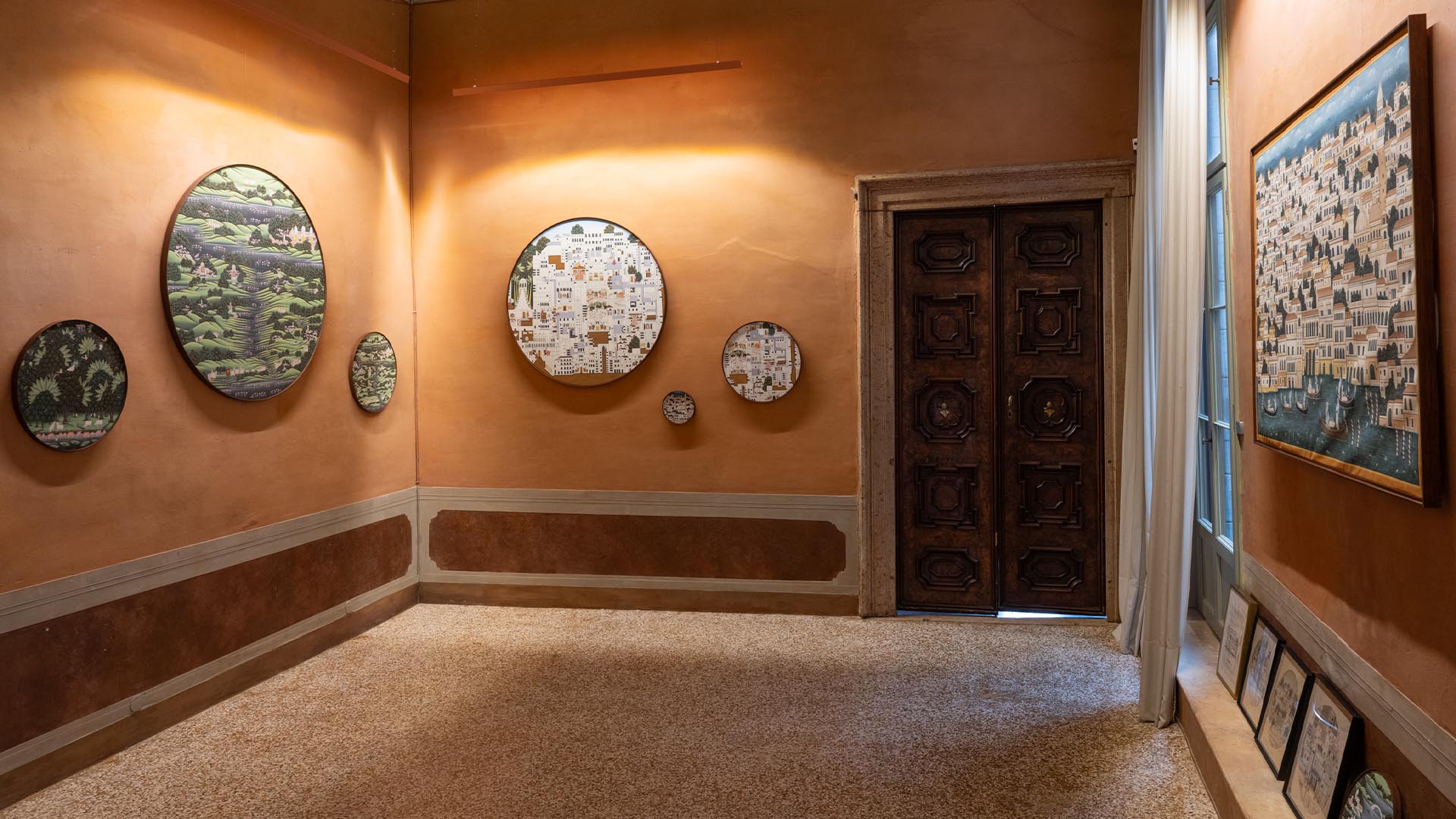
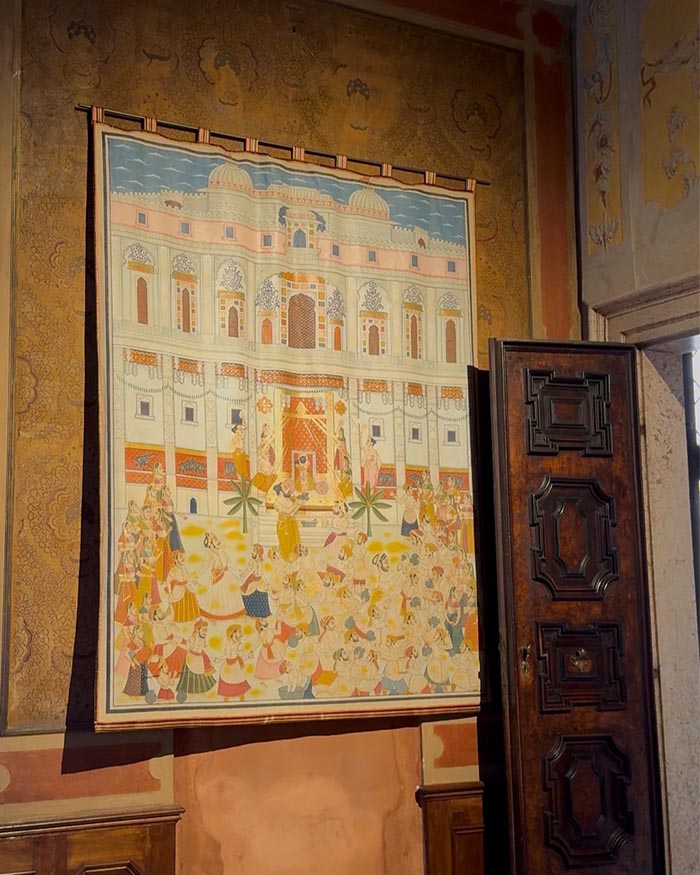
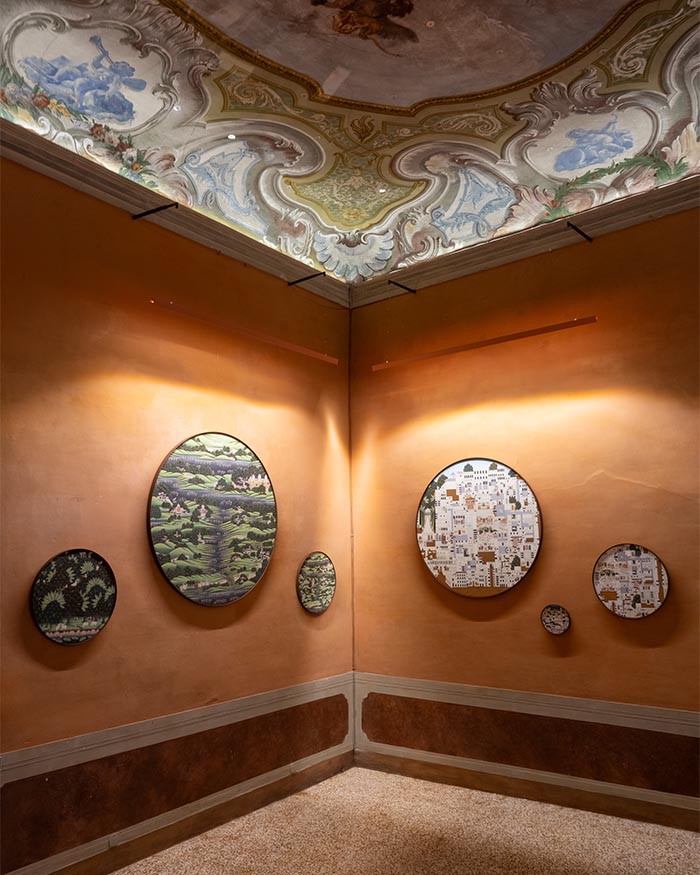
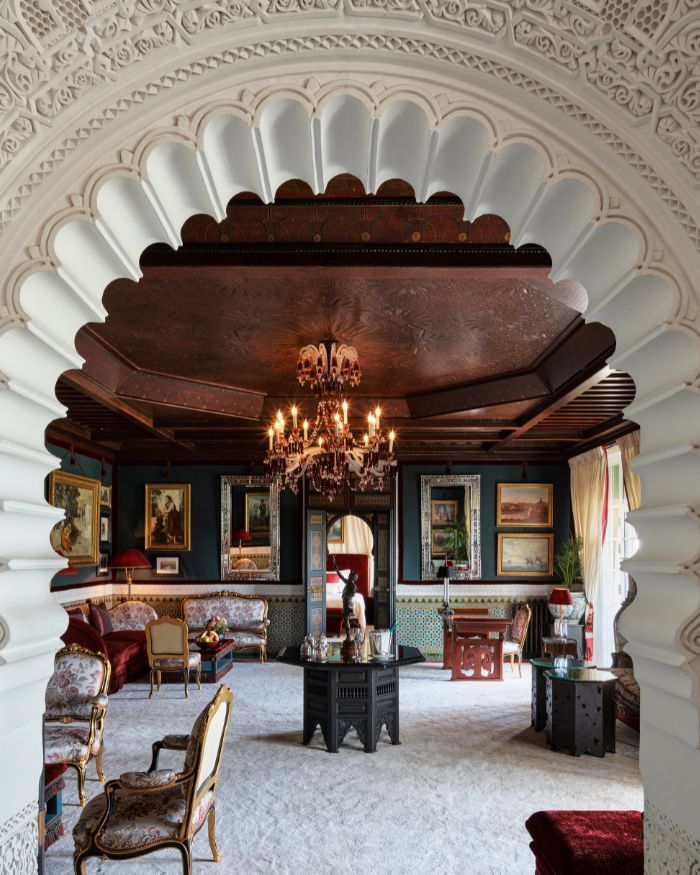
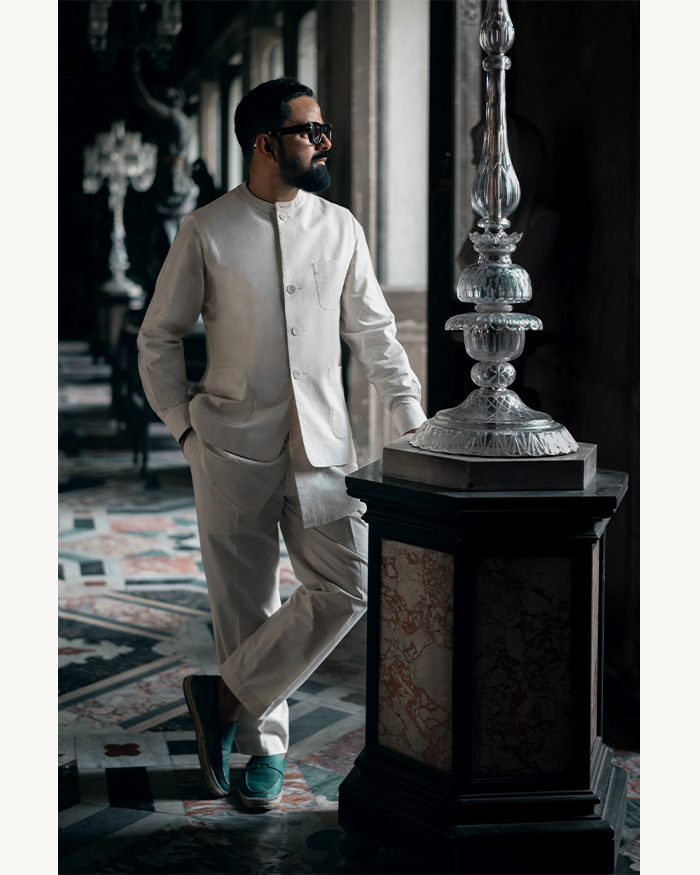
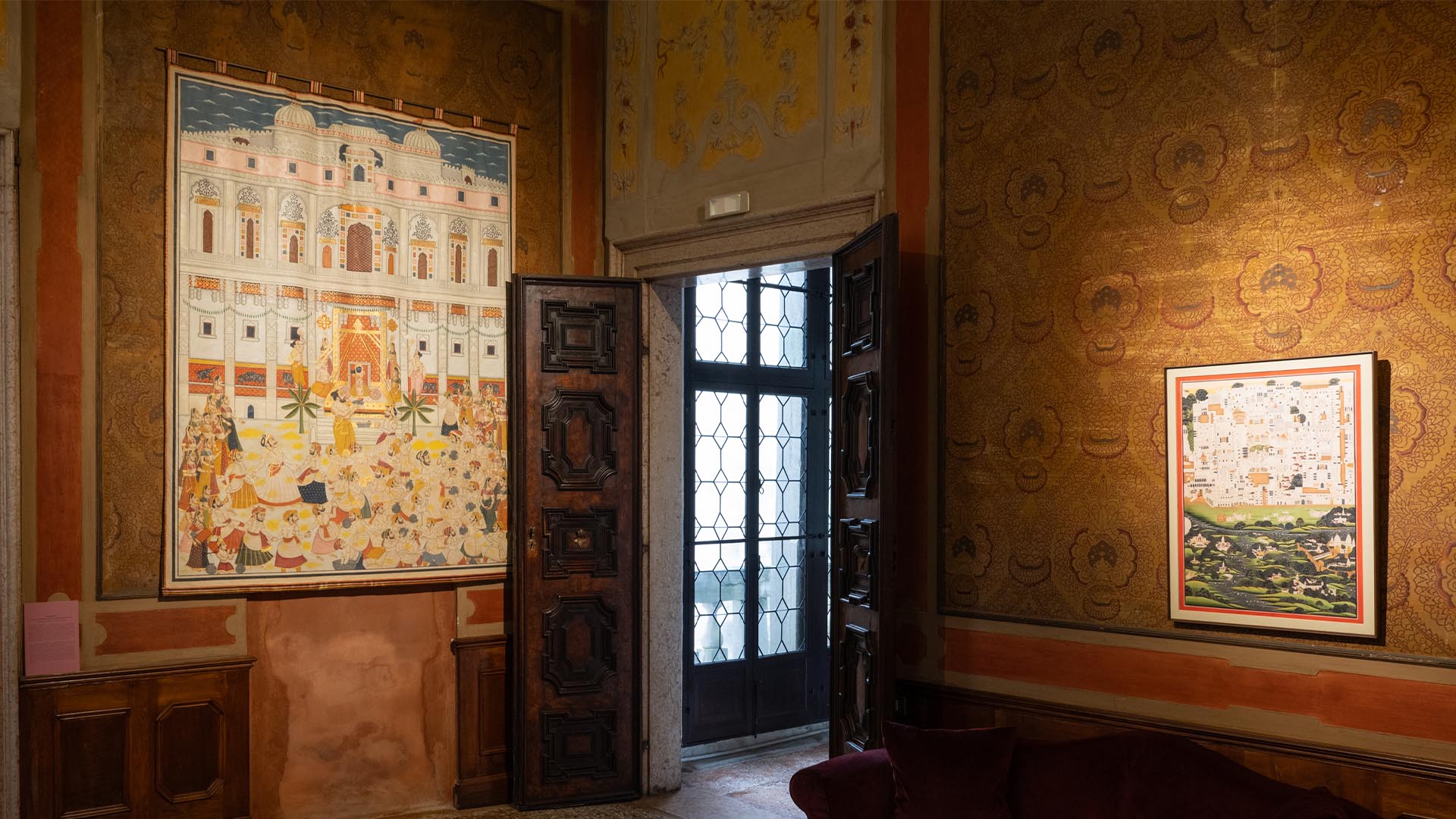
At the precipice of the Grand Canal in Venice, a door opens to a world entirely unto itself. Peeling plaster reveals aged brick. A faint evanescence of terracotta hangs in the air. No signage — or scintilla — gives away the palazzo’s storied history except a single nameplate at the entrance: Curtis. As one mulls over this enigma, Palazzo Barbaro unfurls into a succession of Baroque rooms, replete with painted ceilings, timeworn frescoes and centuries of accumulated memory. Appearing, in contrast yet feeling entirely at home, are Indian Pichwai paintings.

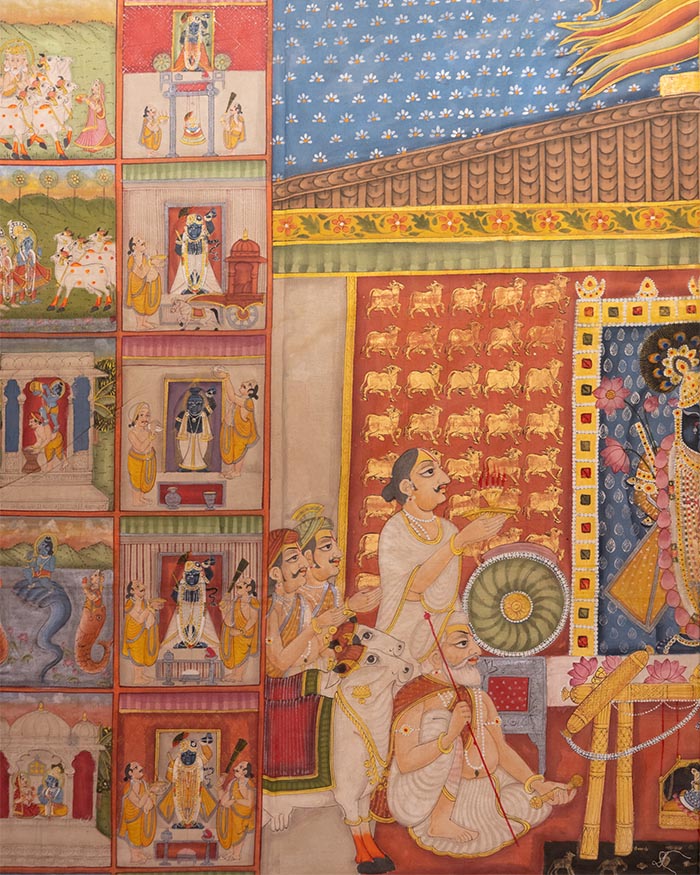
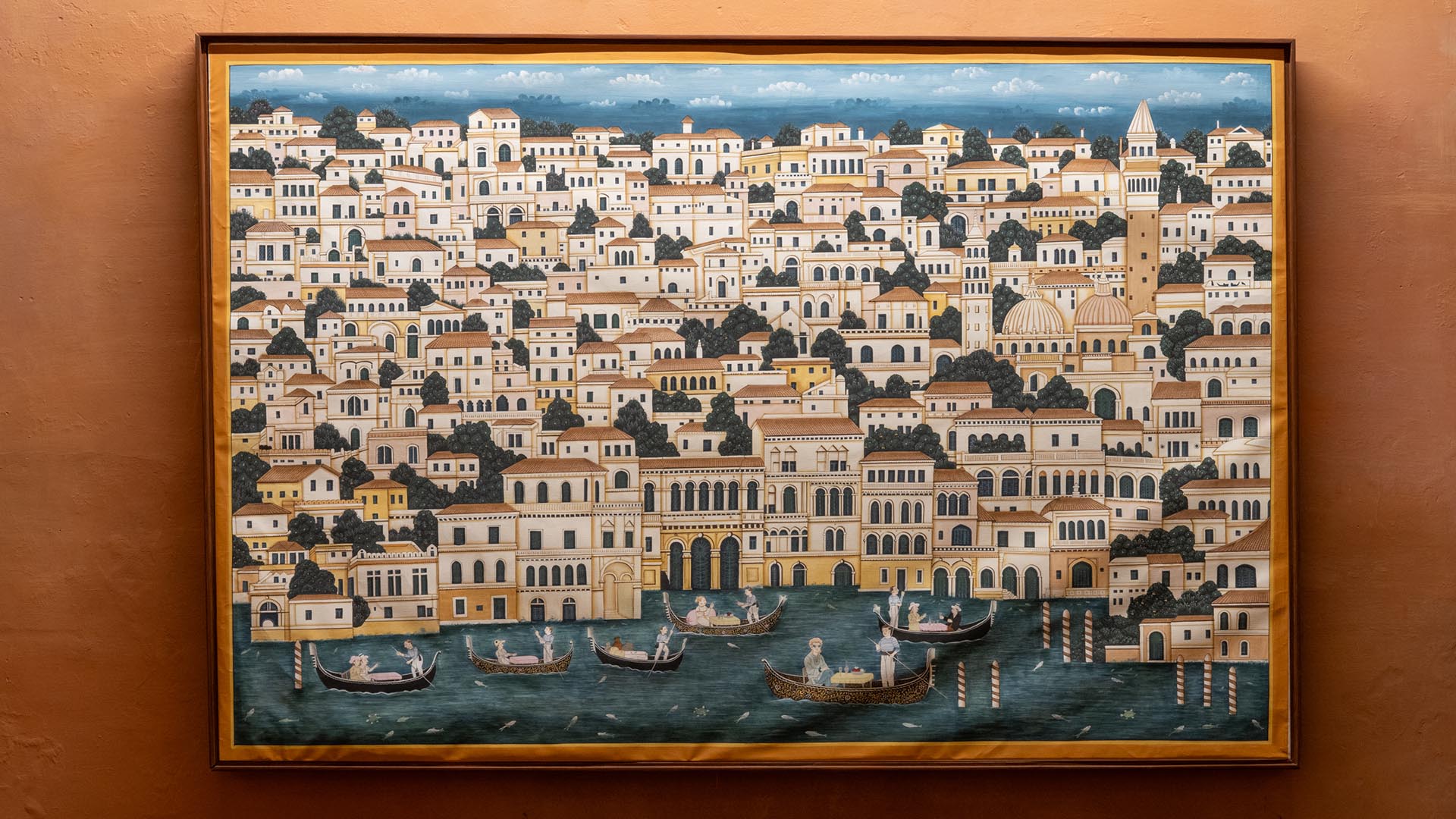
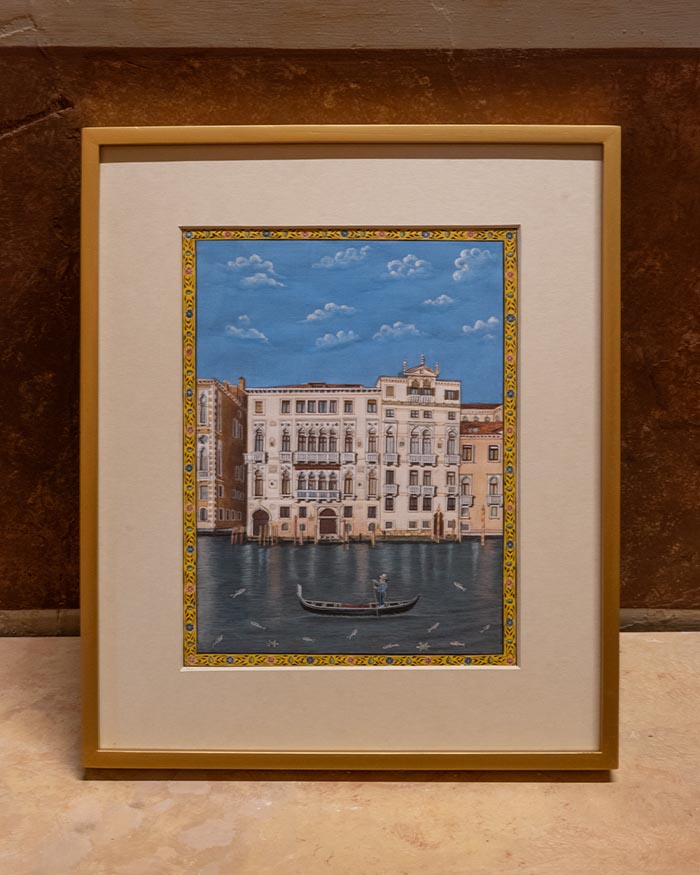
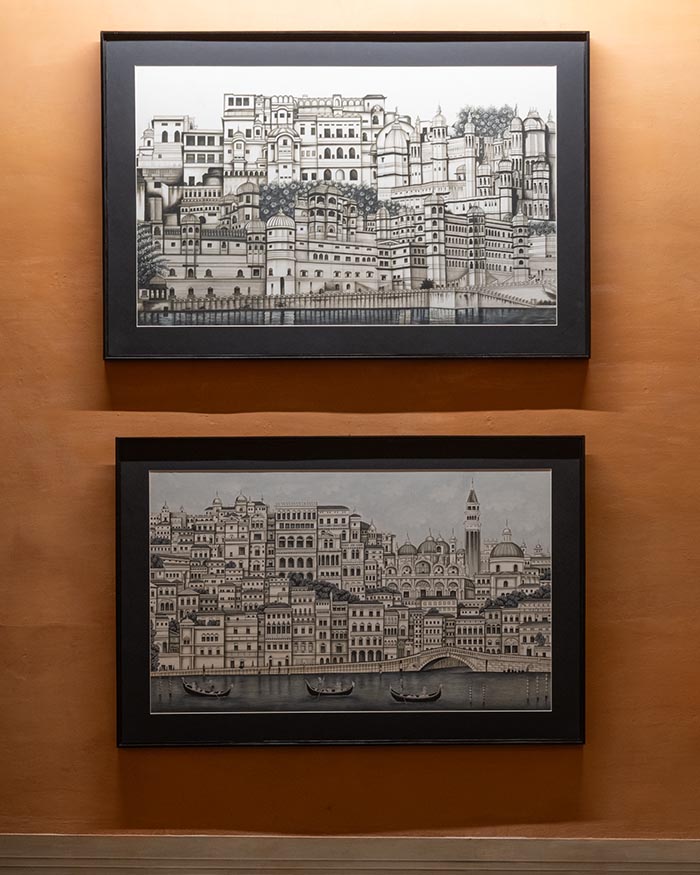
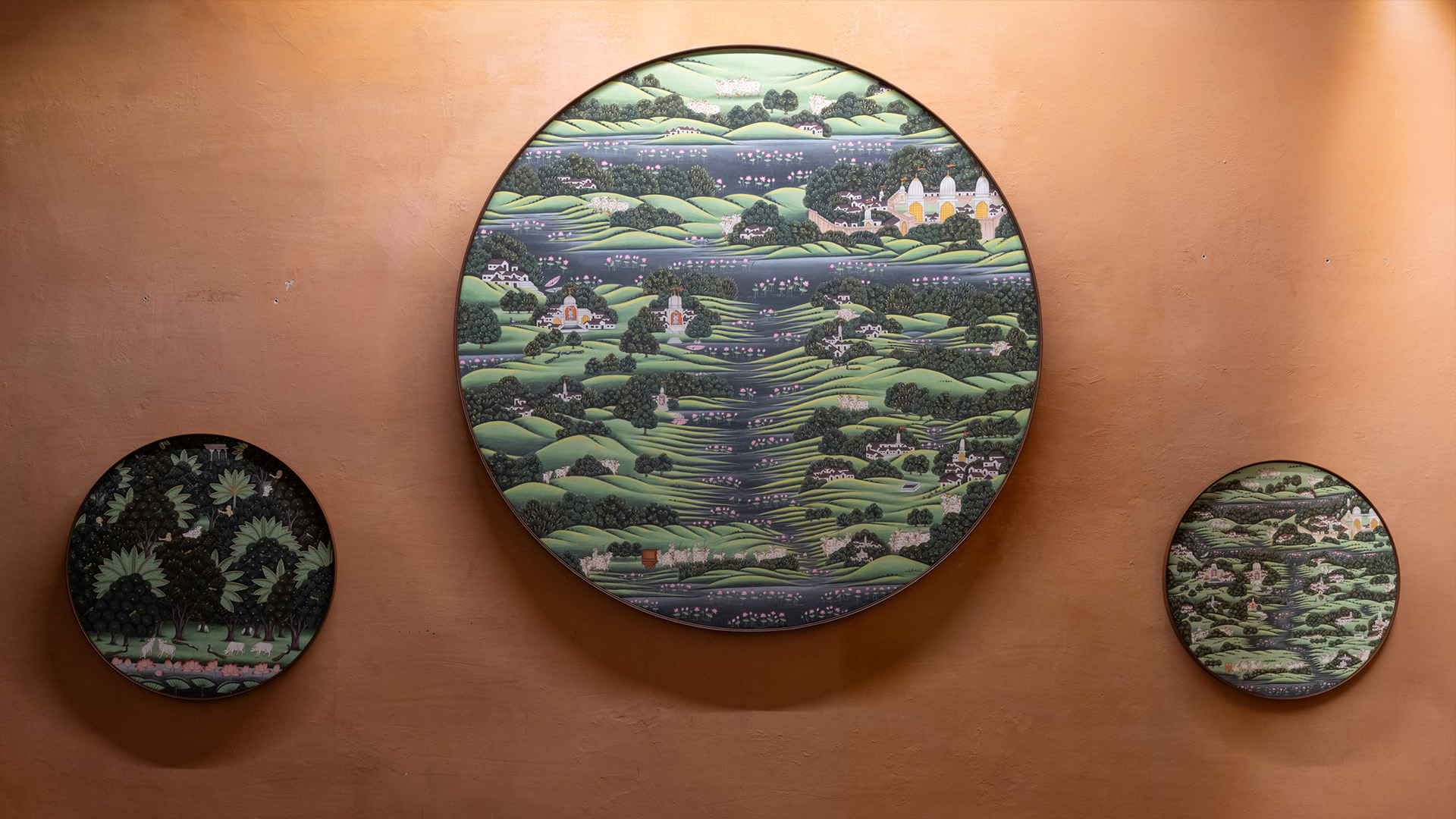
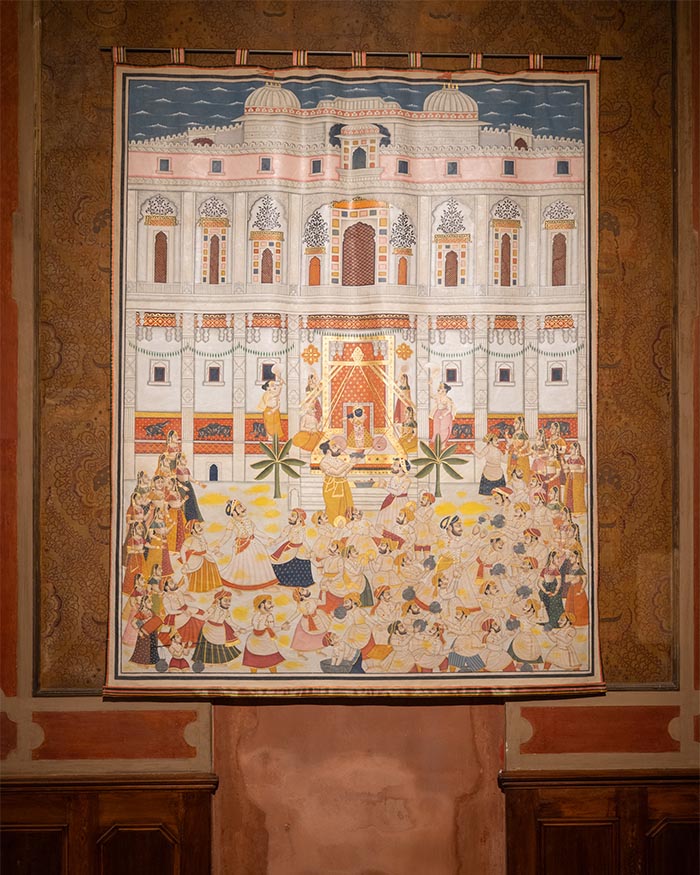
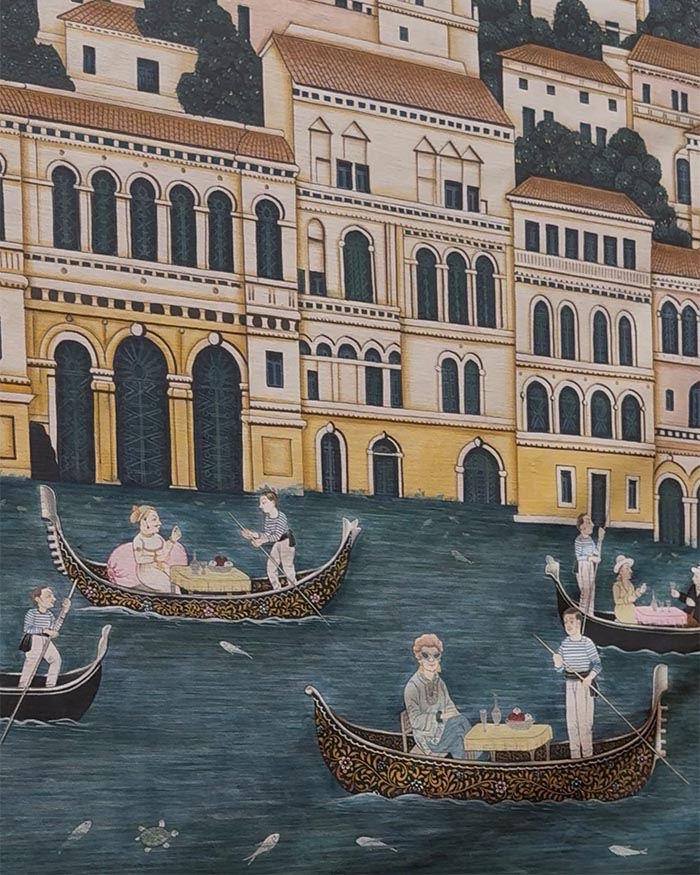
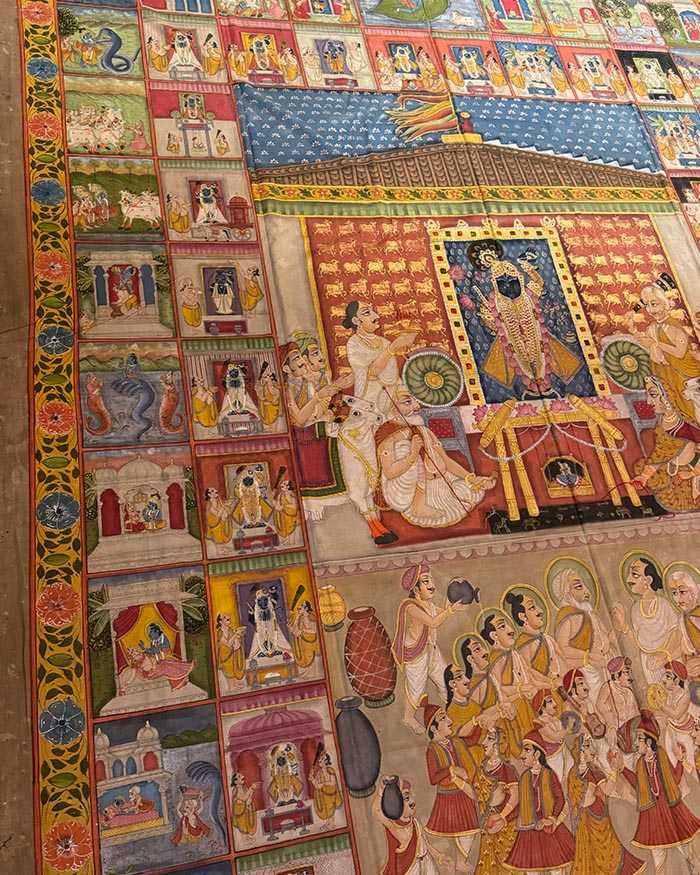
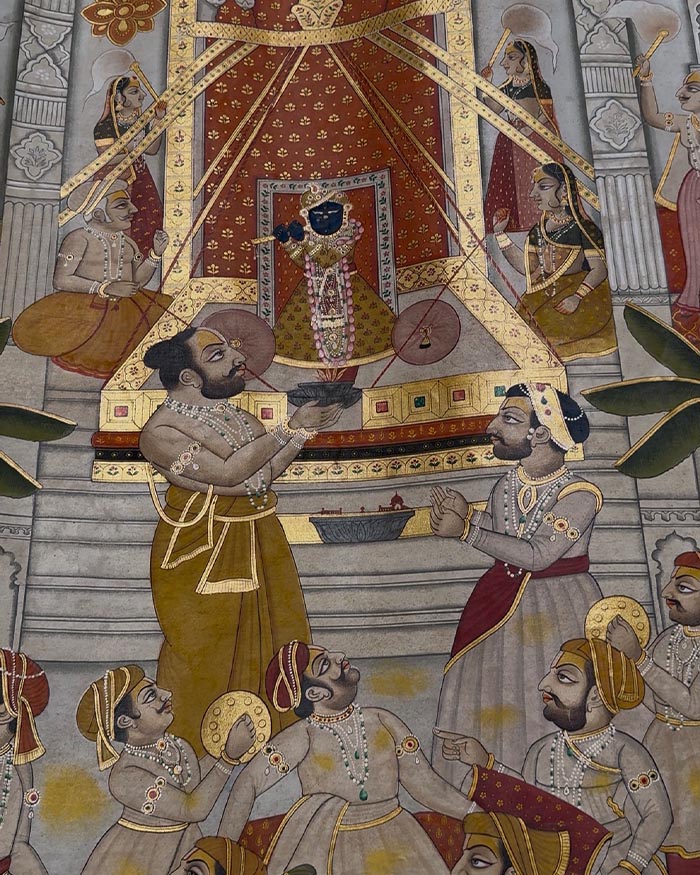
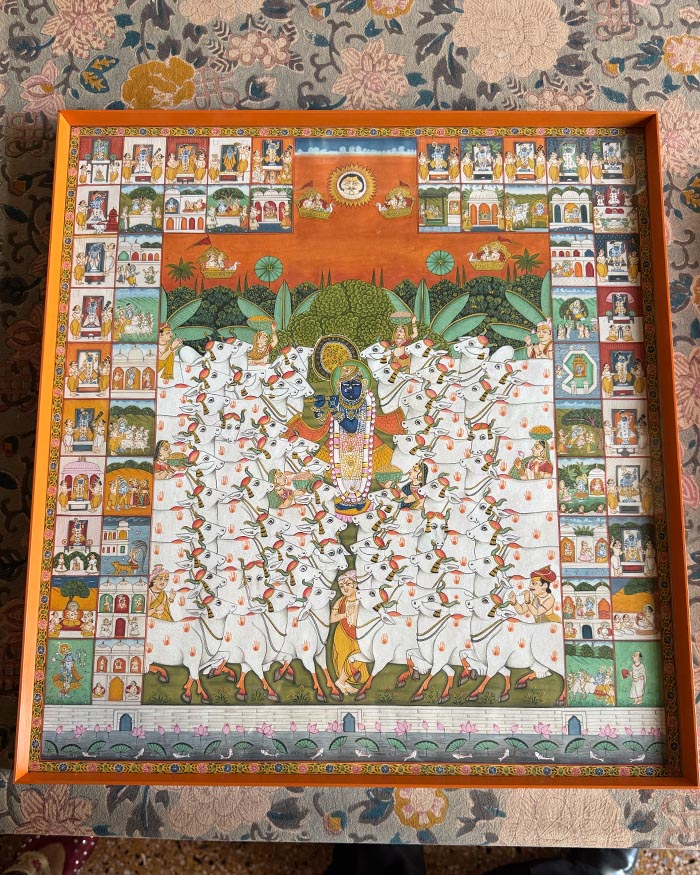
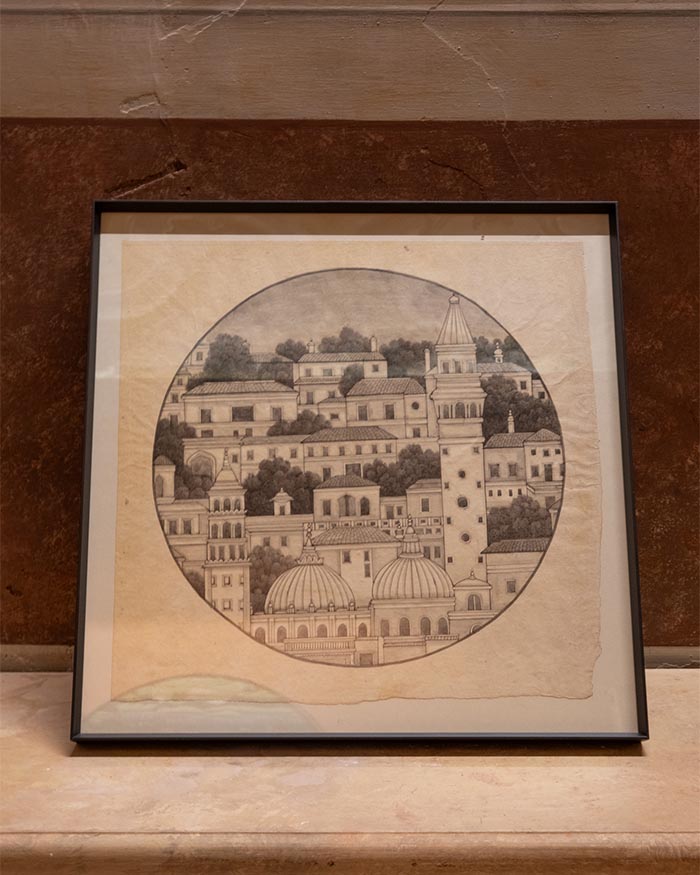
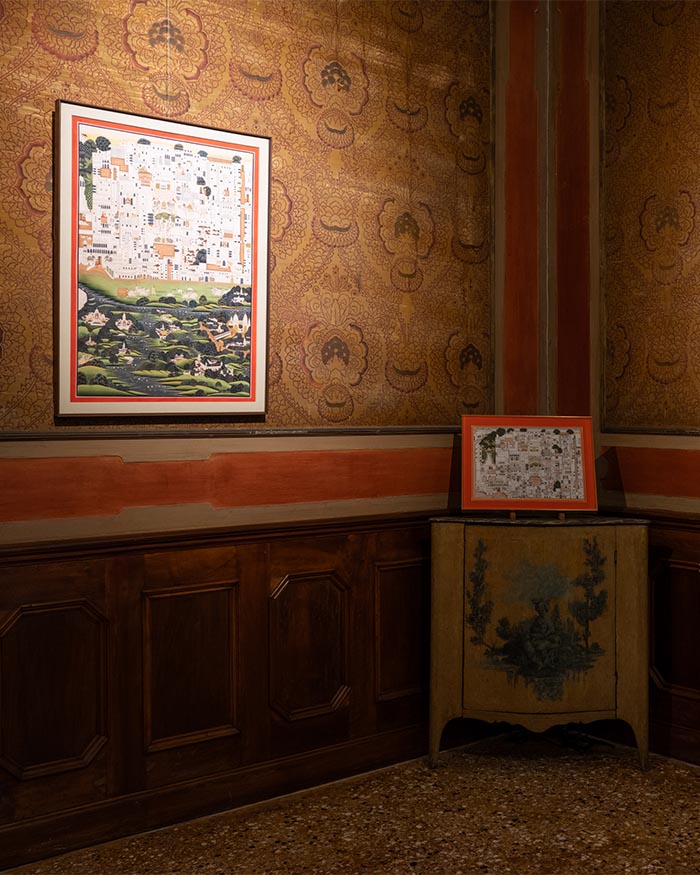
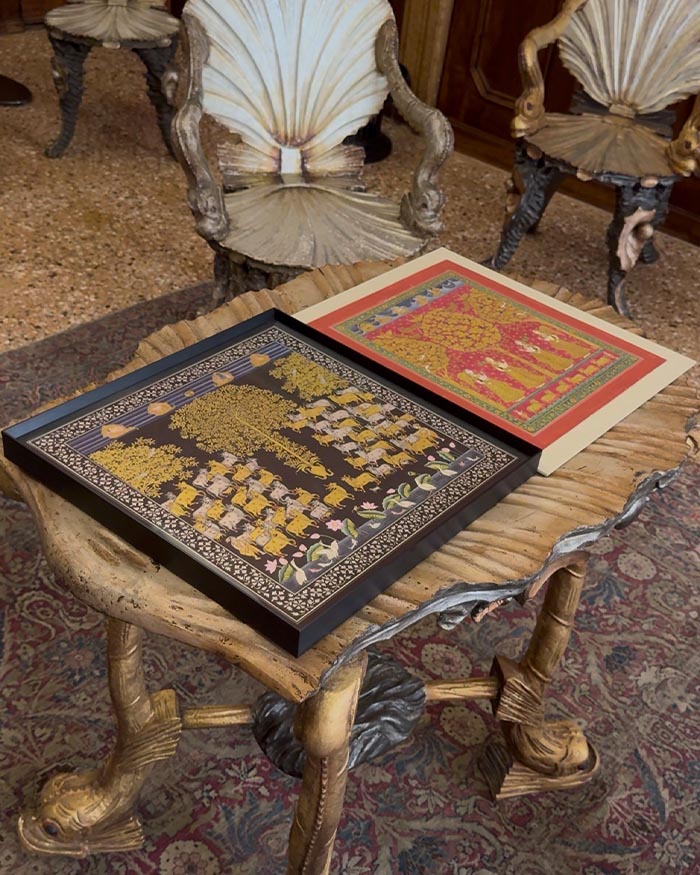
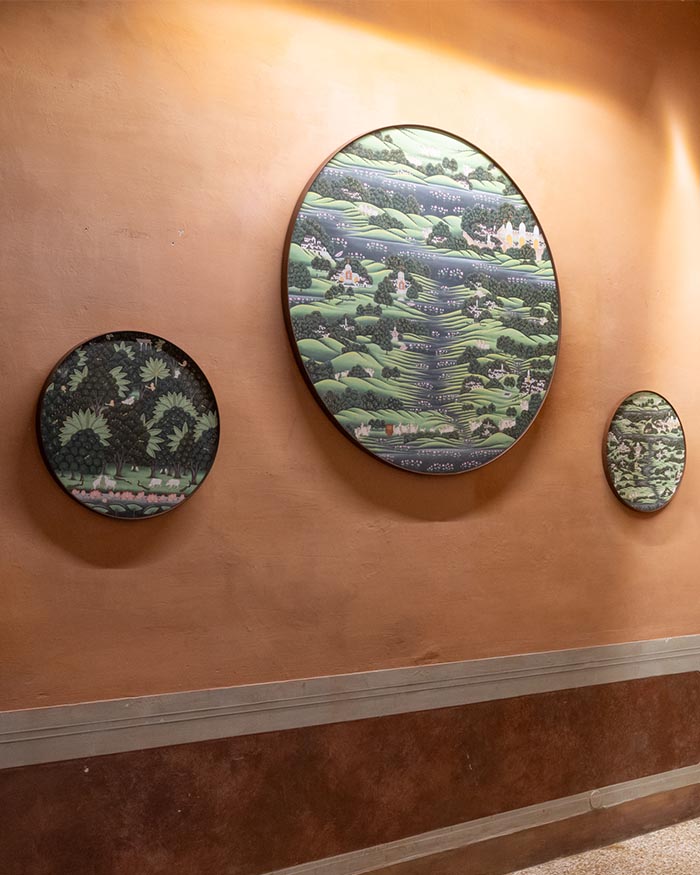
Hailing from Nathdwara in Rajasthan, Pichwais were traditionally painted on cotton-silk textiles and suspended behind the idol of Shrinathji. At the heart of From India to Venice exhibit are ten large-scale works that reimagine the city by the lagoon through the Pichvai tradition. Out of the many highlights, in some artworks, temple maps once employed to depict the haveli of Shrinathji and the sacred topography of Nathdwara now serve as cartographic inspiration. Alongside them are khakhas, the preparatory drawings, now works of art that offer a glimpse into the artistic process. In a few of the visions of Venice, Palazzo Barbaro rises beneath stylised clouds. In others, Gondolas drift through curious perspectives. Fish leap about tranquil canals as though enchanted by this imagined world depicted in luminous stone pigments. In another work, Peggy Guggenheim and Maharaja Bhopal Singh glide through adjacent gondolas, united across geographies and histories. If only Italo Calvino could see this.

“We always think we’re separate from the past, but actually we’re not,” says Pooja Singhal, founder of atelier Pichvai Tradition & Beyond. Invited by French art dealer and curator Elizabeth Royer, she collaborated with Michele Codoni to present From India to Venice at Palazzo Barbaro during the Venice Biennale. Her foremost commitment with the atelier has always been the preservation and reinstatement of the tradition’s rigour. Only then could reinterpretation emerge, as continuity and a way forward.

“A patron doesn’t just consume. They involve themselves in a way that the art emerges and grows”

Photographs Courtesy of atelier Pichvai Tradition & Beyond

THE GAZE OF LIVING CRAFT

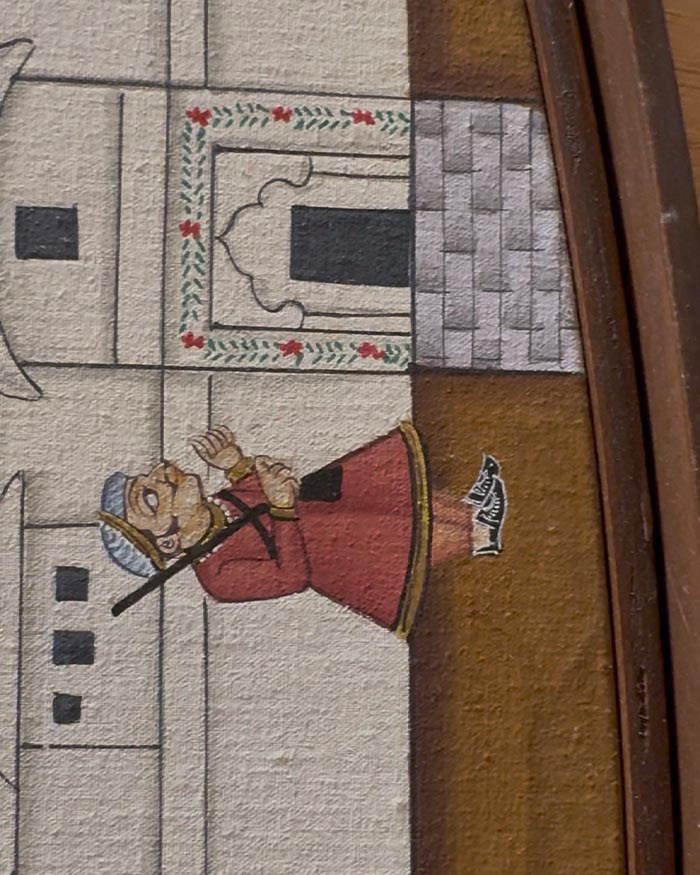
“I value tradition,” Pooja says, “But I also value today’s times. It has allowed me to be who I am as a woman.” Tradition is absolutely important. But it will quickly lose ground if it does not speak today’s language — if it is unable to resonate with newer patrons. The philosophy of revisiting the skill of Pichwai-making is what has fundamentally reshaped the practice of her atelier. Monumental temple hangings have been miniaturised for contemporary homes. Preparatory khakhas (the rough line drawings traditionally used to plan large Pichwais) have become works in their own right. Elsewhere, richly coloured paintings are reimagined into monochromatic greyscale compositions.

For Pooja, these interventions are not stylistic exercises but deliberate ways of opening up the discourse around Pichwai. Her ambition was to demonstrate that a four-hundred-year-old art form belongs as naturally within the cultural landscape of Venice as it does in Nathdwara. At a time when the world is increasingly looking towards India for artistic inspiration, this exchange has a long-standing precedent. Indian traditions have long shaped visual cultures beyond their borders, even if those histories have not always been acknowledged. The exhibition, therefore, is less about introducing Pichwai to a global audience than reclaiming its rightful place within a shared history of artistic exchange. In the storied rooms of Palazzo Barbaro, the living craft escapes the shackles of stasis and claims a seat for itself at the table of global art.

Photographs Courtesy of atelier Pichvai Tradition & Beyond

TIME IN MARCO POLO’S CITY

The exhibition is not a story of sentimentality as one would expect, and the context of Palazzo Barbaro is pertinent to this argument. “For many people, Venice is a nostalgic city,” Elizabeth says as we walk through the rooms, “For me, it is a city that gives me energy.” Recognised internationally for her work in provenance research, particularly Nazi-looted art, Elizabeth has spent decades moving between Paris and Venice. Since renting Palazzo Barbaro in 2017, its historic interiors have turned into a platform for contemporary art, echoing the celebrated salons once hosted here by the American expatriate Daniel Sargent Curtis and Ariana Curtis in the late 19th century. Writers, artists and musicians, including Henry James, John Singer Sargent and Claude Monet, passed through these rooms, making Palazzo Barbaro one of Venice’s most important sites of artistic exchange. “I’ve been coming to Venice for thirty years,” Elizabeth says, “I was less tired travelling to Venice for two days than staying in Paris for the weekend. In psychoanalysis, you say lâcher prise.” To let go. The city slows time. It encourages observation.

Standing before one of the paintings, Elizabeth reaches instinctively for a magnifying glass. “Notice how the flowers are floating,” she says, pointing towards a tiny plant in a vast composition. A trace of the expert hand of the artists. No detail is to be missed. Crafted with a squirrel-hair brush, stories are abound within compositions of all scales: the rhythmic foliage, the architectural facades, the delicate red palms on the joyful white cows. “The poetry and the quality,” she says, are what draw her to Pichwai, an answer that lies at the heart of the exhibition.

“The more you expose the art form,” Pooja states, “the more people will relate to it.” For international audiences to pay such close attention to an Indian craft is the result of her deliberate effort to showcase its objective sophistication. She recalls a European collector who, upon seeing the depth of the atelier’s work, remarked that Indian art deserved to be encountered far beyond India. The exhibition, attended by seasoned collectors from across the world, is a step in that direction. Rather than presenting the paintings as ethnographic curiosities or sacred relics, From India to Venice invites viewers to engage foremost with Pichwai’s graphic character and tacit intelligence.

Photographs Courtesy of atelier Pichvai Tradition & Beyond

PATRONAGE AS A CREATIVE ACT

Growing up in Udaipur, Pooja watched her mother support artists, traders and craftspeople. It was not always about acquiring objects, but about sustaining relationships. The distinction remains central to her. “A patron doesn’t just consume. They involve themselves in a way that the art emerges and grows,” she says. Rather than the father-son lineage through which the craft was traditionally passed down, the atelier of Pichvai Tradition and Beyond operates collectively, bringing together artists who are each skilled in individual aspects of Pichwai painting — borders, drawing, colour, finishing — to produce each work. She says. “Singular, individualistic knowledge wasn’t holistic enough.”

When she started the atelier, there was no dearth of criticism. “People said we were bastardising the art form,” she recalls. “I think criticism gathers steam only if you’re not sure what you’re doing.” As exhibitions multiplied from Kochi to London and now Venice — with the atelier increasingly staging shows of its own — the conversation shifted gears from preservation to progress. So too did the aspiration to own a Pichwai. What was once perceived primarily as a ritual object or heirloom has gradually come to be recognised as a work of contemporary art, finding a place in private collections and modern homes alike. Collectors began to see the paintings as expressions of craftsmanship, cultural memory and artistic innovation. In nurturing a new generation of patrons, the atelier under Pooja’s leadership helped shape the trajectory of patronage itself. Today, the art form is valued for its aesthetic and intellectual depth as much as its devotional origins.

The craftspeople benefited from this exchange too. Families resumed painting. Skills that had once seemed on the verge of disappearing began to flourish with rigour. “They’re able to paint again,” Pooja says. “Their children are able to paint again. They feel proud to belong to something. Pride is of paramount importance to the idea of craft. Like Marco Polo recounting Venice to Kublai Khan, the exhibition travels across time, across geographies and beyond the bounds of possibility — holding the court of a worldly, seasoned audience. It does not present Pichwai, and by extension Indian art, as exalted objects of worship or relics of an exoticised past, but as an expression of skill confident enough to enter into dialogue with another civilisation on equal terms.


Read More: Raja Ravi Varma’s ₹167 crore painting: What’s really valued?

Photographs Courtesy of atelier Pichvai Tradition & Beyond
SHARE THIS ARTICLE

You May Also Like

Watch

No results found.