
Every renovation has an origin story, but few begin as unglamorously as this one: a leaking terrace roof. That was the entire brief, at first. But for interior designer Farah Ahmed Mathias — co-founder, with Dhaval Shellugar, of Bengaluru’s FADD Studio — a leaky roof is rarely just a leaky roof. More often than not, it’s a Trojan horse, and this one snuck its way straight into her childhood. One suggestion led to another, until Farah wasn’t just fixing a house — she was reckoning with everything that had happened inside it.
Because to her, and by extension her parents, this was never merely a project. It was the house her grandfather had built, on a plot bought beside his best friend’s, a decision that must have seemed ordinary enough at the time and ended up shaping the cadence of three generations since. Farah’s father, Nadeem Ahmed, grew up within these walls. Decades later, so did Farah and her older brother, sharing a first-floor bedroom and spending summer afternoons climbing out the window onto the adjoining terrace to frolic, one eye ever trained on their mother’s gloriously overgrown garden below. Then, at fourteen, her room was requisitioned and repurposed into a music room, a shift the renovation would, years later and rather sweetly, choose to honour instead of erase.
“My mom insisted on restoring it. I was adamant it should be left as is"
Farah Ahmed Mathias

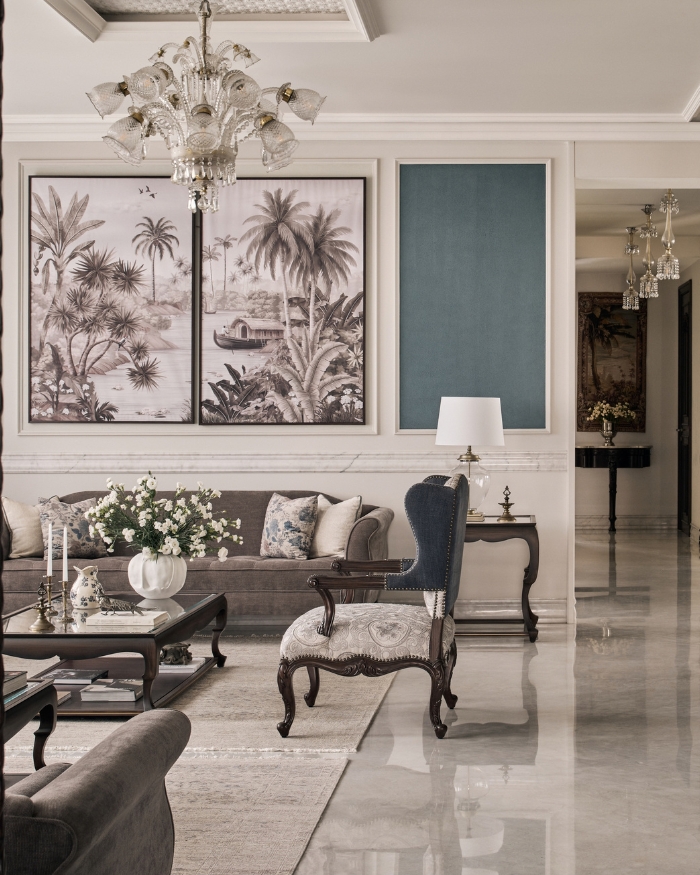
If there’s a single instinct that guided Farah through this project, it’s that erasing was never really the plan. The marble flooring stayed, as did the living and dining rooms’ proportions. She let the house’s bones set the terms, and negotiated everything else around her parents, who no longer needed five bedrooms now that Farah and her brother had long since moved out. Five became three — and each one, in its way, tells you something about who lives there now, or who once did. Her parents sleep upstairs in a terracotta dream, limewashed and hand-painted with oversized blooms.
Downstairs, her grandfather’s old room has become the guest bedroom, all warm whites and painterly palm wallpaper. And when Farah’s and her brother’s children come to stay, they claim a third room entirely — an English-inspired retreat of blue stripes and Tiffany lamps, with a dramatic black backlit marble vanity that turns their bathroom routine into something faintly theatrical. It’s a small joke of a detail, but Farah can’t resist pointing out that every bedroom, even in her grandfather’s original 1960s design, comes with its own ensuite dressing room. “The architect was ahead of his time,” she says.


It’s Farah’s vision, though, that you feel most in the paint — the thread she used to stitch her parents’ house back into a single, coherent world. Long before FADD Studio, her mother had her own life in fashion design, and Farah still remembers tagging along as a child to watch the karigars at work — dazzling borders taking shape under their hands, wondrous fabrics being dyed from plain white into layered, shaded colours.
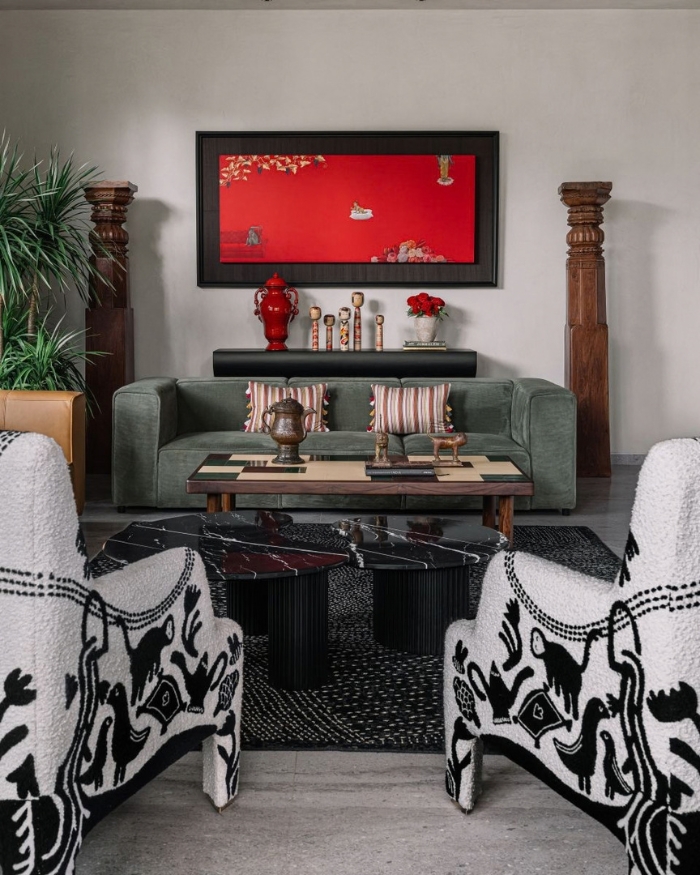
Those afternoons never really left her, and they resurface now in the house’s motifs: black-and-white patterning in the living room gives way to painterly triangles along the rafters; oversized florals spill from her parents’ bedroom into delicate botanicals lining the upstairs passage; vintage blooms turn up again in her kids’ room; brushwork trails outside the old music room, now reinvented as her mother’s yoga space. Walk through it and the house starts to feel like one continuous canvas, commissioned by a daughter for the people who raised her.


Just outside her parents’ bedroom sits an anteroom where the family once gathered for TV nights — now fully annexed by their three cats, who clearly won that particular renovation. Below it, though, lies Farah’s boldest move: her own teenage bedroom, reimagined as her mother’s dressing room, now connects directly to the primary bedroom above via a circular glass capsule lift. “We’d always joked about puncturing the ceiling,” Farah says, “but nobody really thought about it seriously.” Until she did — for her mother, who now descends into a room with a black-and-white Indochine mood, elegant balustered railings, a glass-enclosed toilet and shower, and a calming corner reserved just for her massages. Farah shifted an old foyer arch to make the layout work, careful not to disturb the entry sequence her grandfather had set decades before.
That same refusal to take no for an answer runs through the ground floor. When the living and dining rooms’ flooring couldn’t budge, Farah simply sent the eye skyward instead — rafters and a hand-painted floral band pulling attention up toward the first- floor gallery, while pocket vaults in the dining passage lend the corridor an airy lift.


Above the dining table, a ceiling shaped by five separate hands layers mirror panels, Sabyasachi For Nilaya wallpaper, pink cement, ceramic flowers by New Delhi-based Pretty Potter Studio, and hand-drawn gilded leaves into a collage that feels less like decor and more like a family archive rendered in materials.
Because that, in many ways, is what this house has become. On its walls hangs artwork by Farah’s mother, Asma Ahmed, much of it only recently rescued from decades in storage — a magnificent bouquet in the living room, and in the foyer, a portrait of a gaunt man with haunting eyes, slightly worn from its years away. Mother and daughter disagreed on what to do with the damage. “My mom insisted on restoring it. I was adamant it should be left as is,” Farah says. Her instinct won. It wears its age beautifully — much like the house itself.


Upstairs, past the door of what was once Farah’s bedroom, time seems to have simply stopped. The music room is a capsule now: gabled timber ceiling, vintage glass chandelier, maroon tufted slipper chairs, a wall-to-wall Jaipur Rugs carpet, fanlight windows onto the terrace. Its real centrepiece, though, is a wall of glass-fronted cupboards holding the family’s CD collection, digitised and catalogued so thoroughly by Farah’s father that, in her words, “you can look up a song and know immediately which cupboard it’s in, on what shelf, between which other CDs.” A few steps beyond, through the terrace doors, is her mother’s art and design studio — a former storeroom turned sunroom out of a storybook, its trellis walls and sunburst windows feeling lifted straight off a page.
Even the house’s stray pieces feel like family: an Edra sofa and furniture ferried over from other chapters of their lives, an unplaceable Chinese console painted with figures who have no eyes, a bean-shaped table tucked under the staircase, crafted by Farah’s great-grandfather, the well-known furniture maker Saleh Ahmed. Nothing here was bought to match. It was bought, or made, or inherited, to mean something — and Farah’s real feat wasn’t styling a house at all. It was making sure that everyone in it, across three generations, still had a place to be exactly who they’d always been.

No results found.