Subodh Gupta Mumbai NMACC
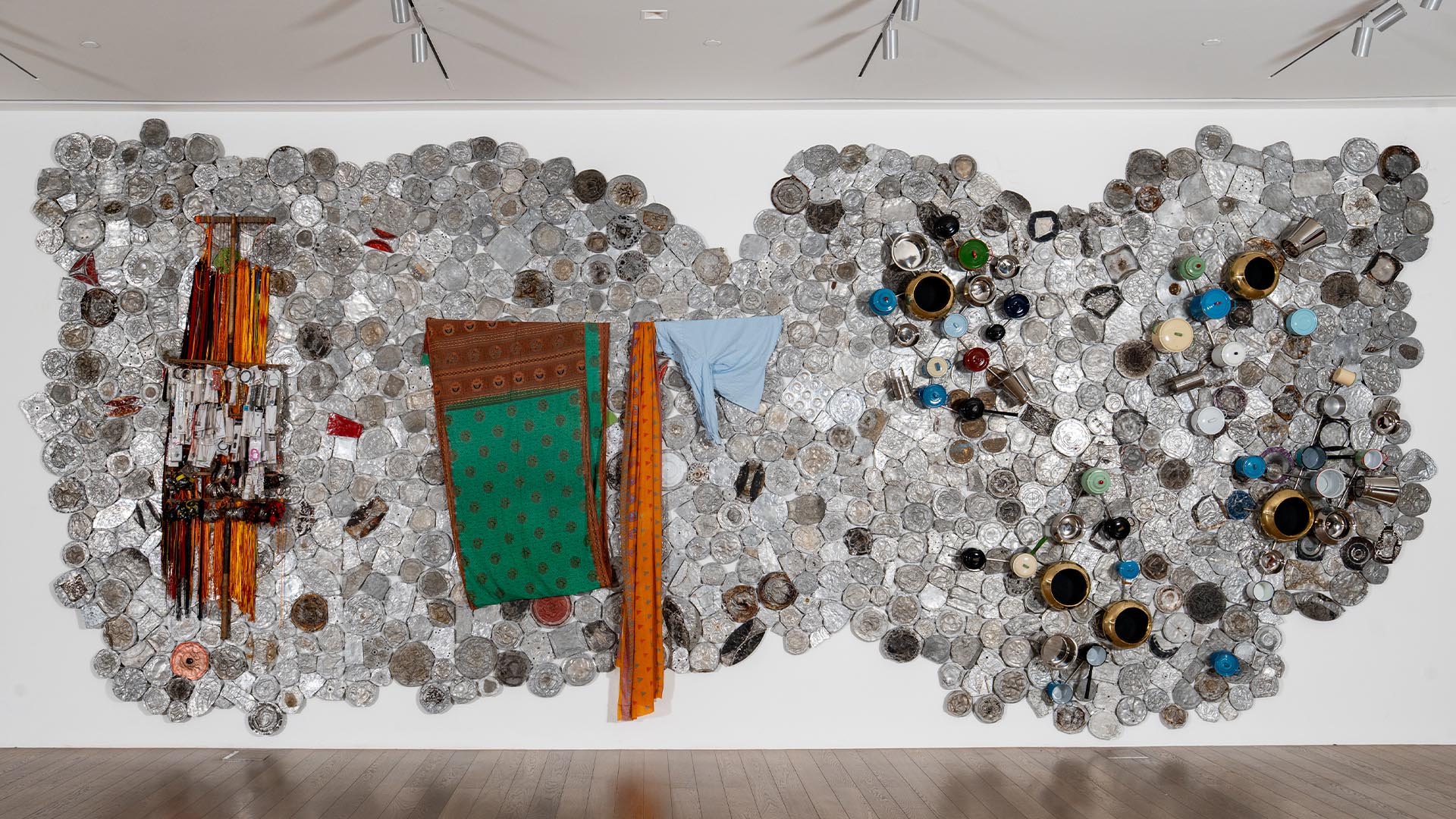
Proust Mapping (2024-26) by Subodh Gupta created out of brass, stainless steel, aluminium, enamel, found objects and clothes; Photograph courtesy Nature Morte and the artist

How space shapes Subodh Gupta’s show in Mumbai

Through a dreamlike environment of beds, ruins and utensils, Subodh Gupta constructs an ascending narrative across four levels at NMACC Mumbai

BY

Space operates as a powerful instigator of memory, fostering belonging while simultaneously enforcing boundaries. In a solo exhibition by Subodh Gupta called A Fistful of Sky, this intangible yet ever-present condition becomes a structuring device, guiding the viewer’s encounter with the works. The title, when read in Hindi, evokes the well-known 1973 song by Kishore Kumar: Har koi chahta hai, ek mutthee aasman. In pursuit of this metaphorical sky — another elusive yet persistent presence — the exhibition unfolds vertically across the four floors of the Art House at NMACC in Mumbai. Claire Lilley, the curator of the exhibition supported by Nature Morte, writes, “Each level unfolds as a staged environment in which domestic ritual, dream, motion and reflection interweave. The exhibition rises through these interconnected states, mirroring both the artist’s own trajectory and the social and economic transformations that shape contemporary India.”

The exhibition is organised into four conceptual strata, each articulating distinct yet interrelated conditions. The first level, foregrounding discipline, ritual, belief and threshold, introduces School (2008). This installation comprises a grid of chowkis, low-seating furniture common in Bihar, where the artist grew up. Typically associated with communal gatherings, the chowki is embedded within an unspoken social discipline, wherein individuals resist being the first to rise, a behavioural nuance that informs the work’s title. The piece is also inflected with Subodh’s personal memory, “About 10-15 years ago, when I went back home, I found this stool that my father used to sit on, and I picked it up and brought it with me to the studio.” This intimate association is materialised through the engraving of his father’s initials on the brass surfaces of the stools.

“The object itself does not change. What changes is the situation around it. In a home, it is part of routine; you use it without thinking. In an exhibition, it is placed, repeated, or brought together with other objects, and that shifts how you see it. For me, the work is about creating that condition. When objects come together at a certain scale, they begin to hold space differently. You slow down, you notice them, and they start carrying other meanings”

Subodh Gupta Mumbai NMACC
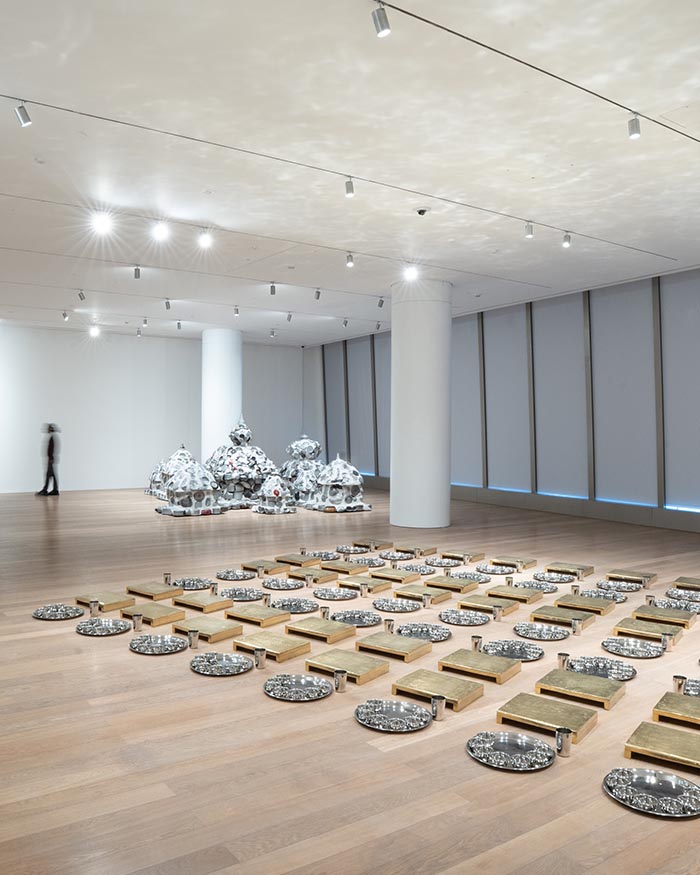
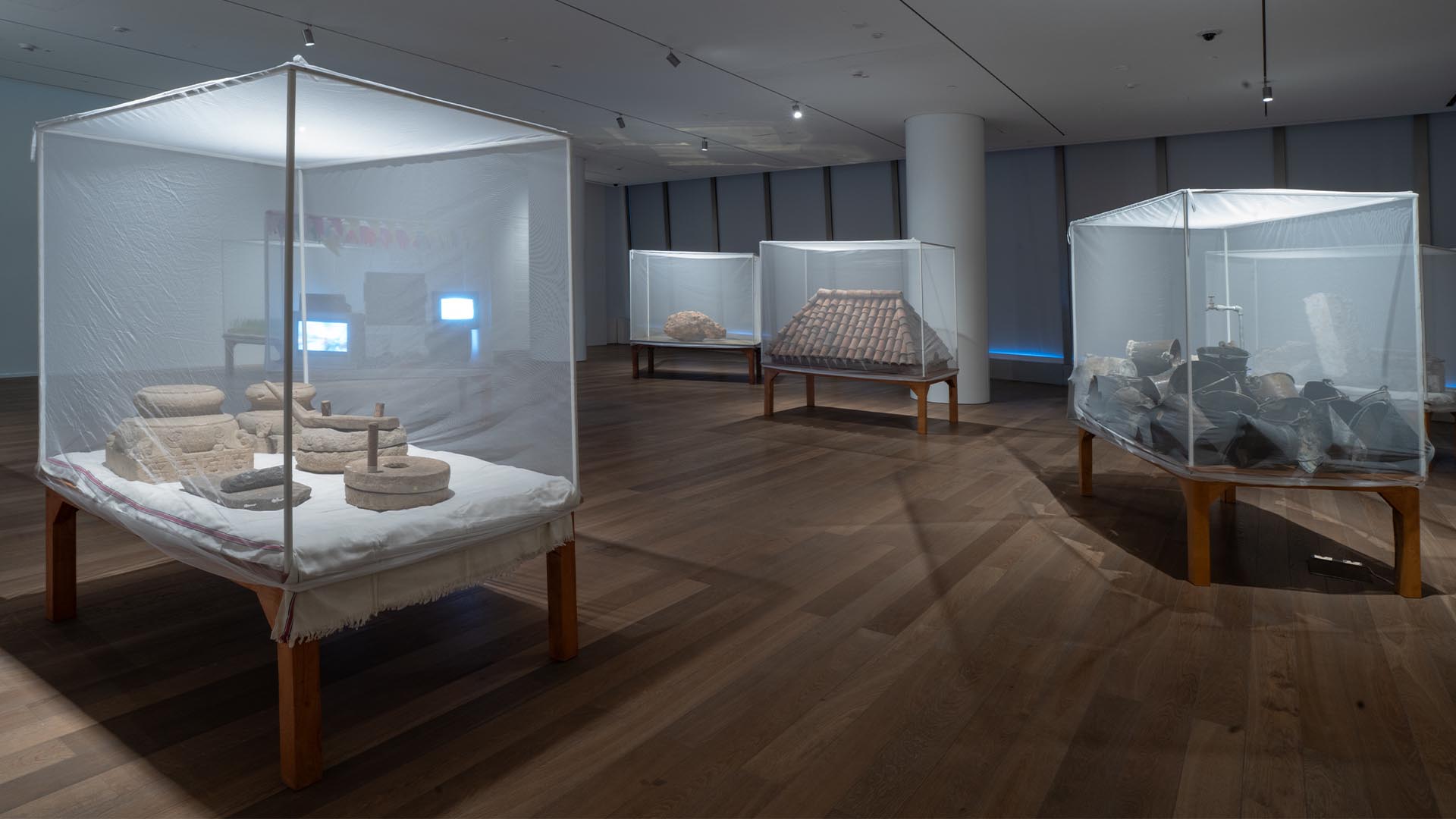
The second level of the exhibition is structured around dreams, shelter and memory; Photograph courtesy Nature Morte and the artist

If School occupies the floor plane, the adjacent wall hosts Proust Effect (2026), a constellation of beaten aluminium utensils, a material with which Gupta is closely associated. The work aggregates objects sourced from across the country: scrap metal fragments, enamelware once included in brides’ dowries in Chettinad, and religious totems and keychains sold on the street. Together, they form an expansive field of exchange and memory. Just as one turns to move upstairs, they come across a relatively inconspicuous corner which holds Door (2007), a polished brass threshold with a thin band of light suggesting infinite possibility beyond.

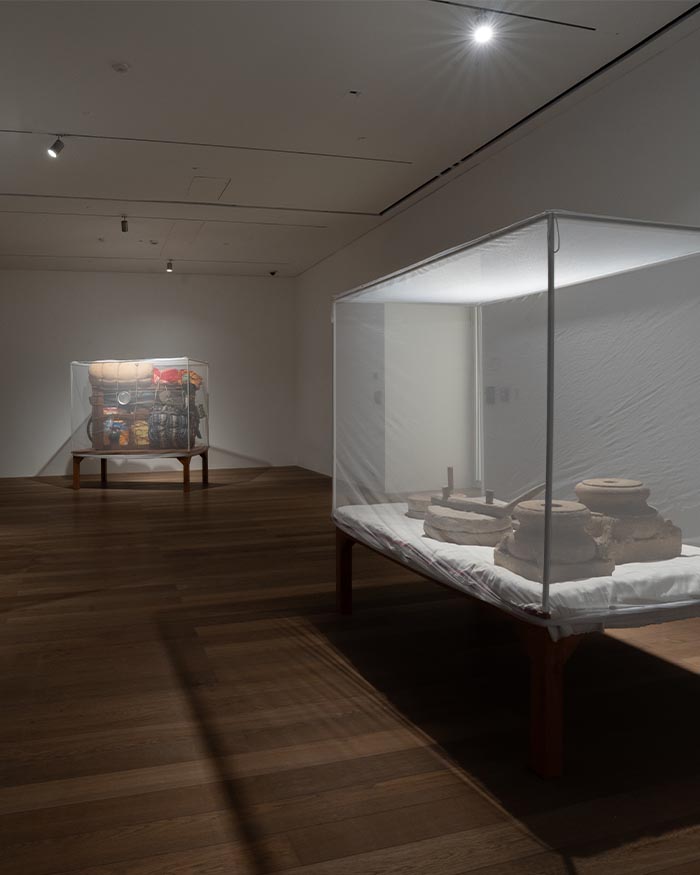
All of these objects are commonplace in a domestic setting, but what about the setting changes the way we perceive them? “The object itself does not change. It comes from the same place, it has been used in the same way,” explains Subodh, “What changes is the situation around it. In a home, it is part of routine; you use it without thinking. In an exhibition, it is no longer used in that way. It is placed, repeated, or brought together with other objects, and that shifts how you see it. For me, the work is about creating that condition. When objects come together at a certain scale, they begin to hold space differently. You slow down, you notice them, and they start carrying other meanings.” The second level, structured around dreams, shelter and memory, extends these concerns through a newly commissioned installation of nine mosquito-netted beds. The work evokes themes of ritual, faith, death, transit and migration, situating the domestic within a broader continuum of movement and temporality. Peter Nagy, co-director of Nature Morte, notes, “We are used to seeing objects of value in containers of acrylic or glass in a museum. It is interesting to take a bed and a mosquito net instead, things that can be found by the side of the road and place art and artefacts, the very top of the commodity spectrum within them.”

Subodh Gupta Mumbai NMACC
On the second level, Subodh Gupta places objects and artefacts on beds encased with mosquito nets; Photograph courtesy Nature Morte and the artist
Subodh Gupta Mumbai NMACC
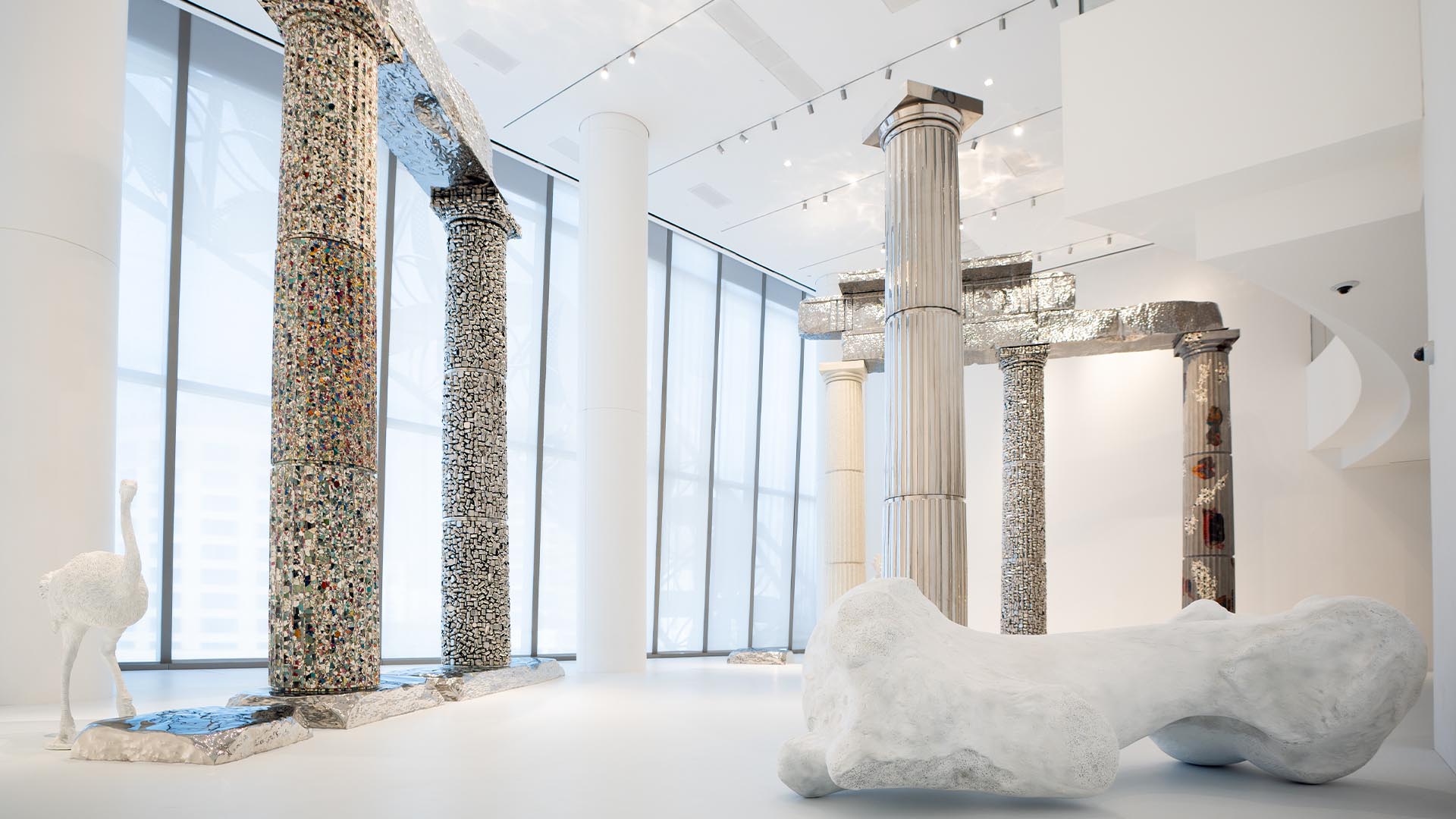
The third level titled Ruin, Deep Time, Future Relics, opens up panoramic views through a glass facade that creates an ethereal and otherworldly atmosphere; Photograph courtesy Nature Morte and the artist

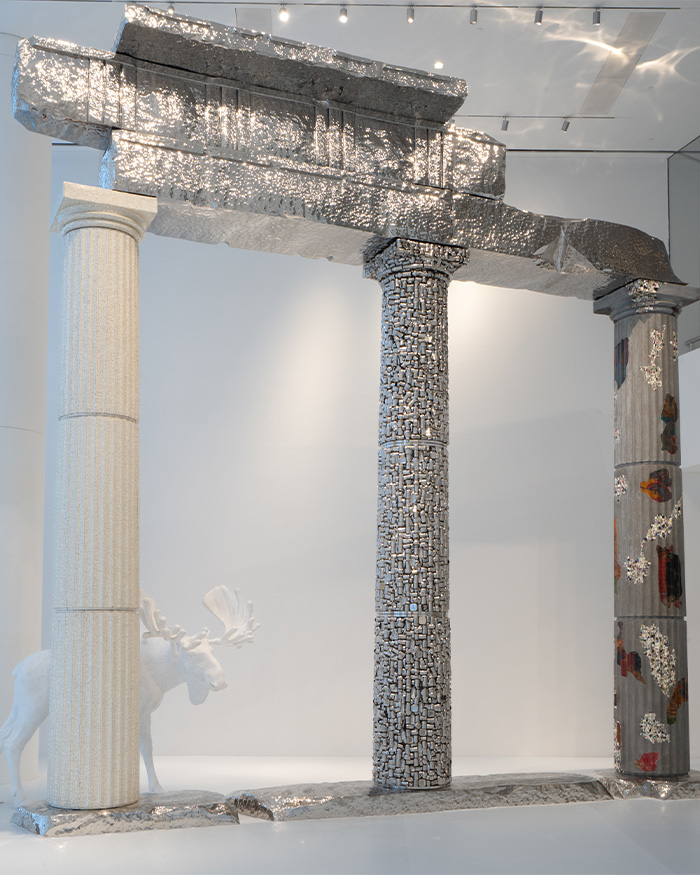
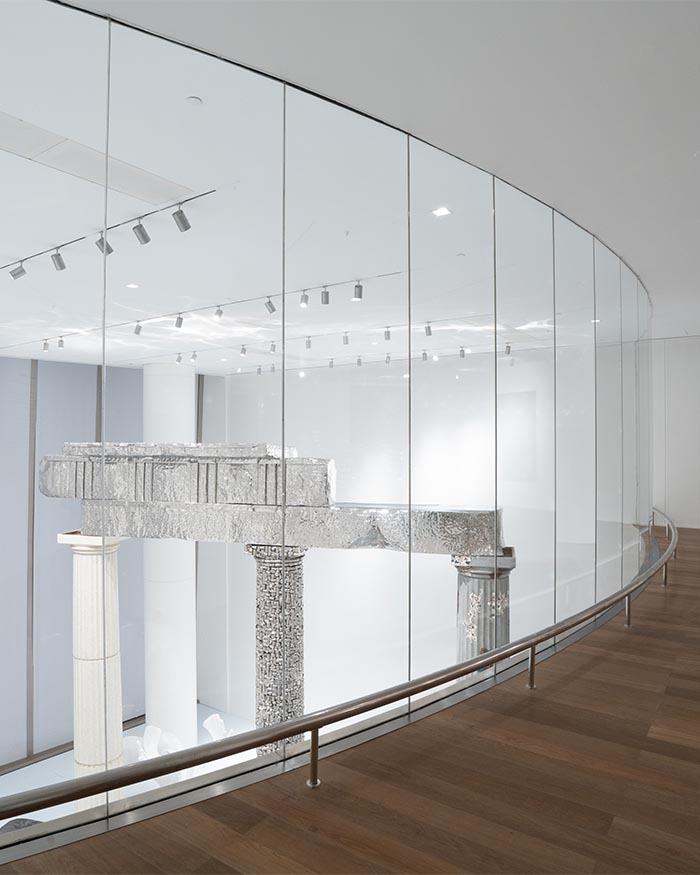
A marked shift occurs on the third level, titled Ruin, Deep Time, Future Relics. Where the preceding level is characterised by grounding elements such as water, grass and earth, this floor adopts a more distanced, almost archaeological perspective. At its centre is Kingdom of Earth, a work developed over a decade. Drawing from the remains of the Delos Gate in ancient Greece, the installation features seventeen-foot-tall Doric columns, some rendered in pristine white cement, others dotted with scrunched printed sarees. Interspersed among them are sculptural forms, including a moose and an enlarged prehistoric rhinoceros bone. In combination with the daylight filtering in from outside, the experience reads like a hallucination of a post-anthropocene reality, especially considering the glass towers of the Bandra-Kurla complex in the distance, an architectural irregularity in a tropical climate, just as much as the Classical columns.

Subodh Gupta Mumbai NMACC
A detail of the monumental columns of the Kingdom of Earth (2016-26); Photograph courtesy Nature Morte and the artist
Subodh Gupta Mumbai NMACC
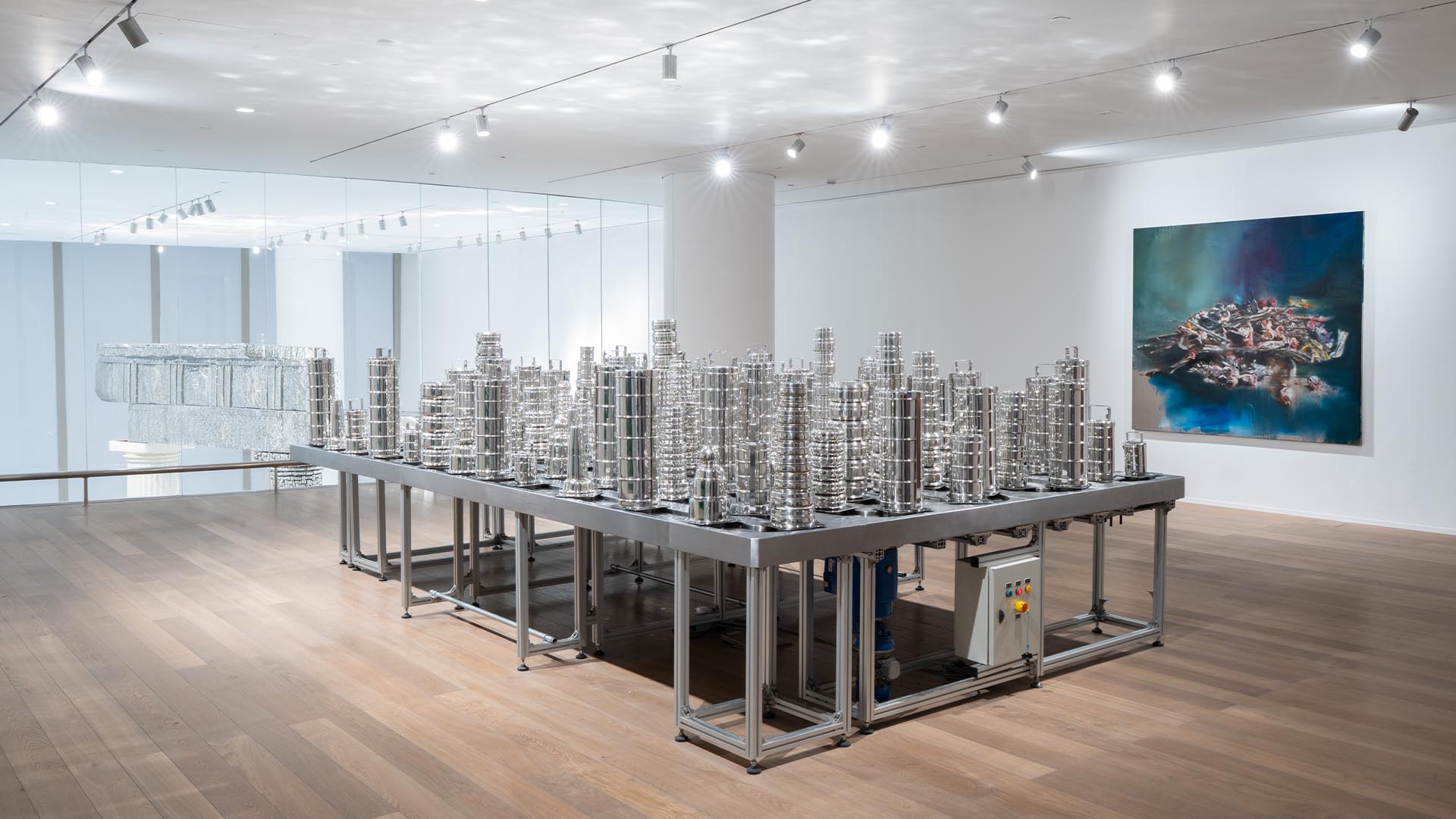
Faith Matters (2007-2010) placed on the fourth and final level; Photograph courtesy Nature Morte and the artist

Along the same lines of contextual distance is the fourth level called Circulation, Motion and Renewal. Stainless steel dabbas form a conveyor belt-like system in an artwork called Faith Matters, created over three years starting from 2007. Reminiscent of a sushi bar or the airport baggage belt, it reminds one of how intimate domestic rituals travel across the globe. “The story of how food travels is a story of the Silk Route, of the spice route and how trade happened,” explains Subodh. Owing to the glass window connecting the lower level to this level, one can make connections between the two ideas: between renewal and ruin. Like a train of thought, time itself is interpreted through the four-storey structure of the exhibition, with scale, material and context operating as critical agents of meaning-making. From the simple chowki and dabba to the mammoth columns, the shrinking and expanding of space makes one anticipate reaching the metaphorical “fistful of sky”. Yet this trajectory remains deliberately unresolved. When glimpsed on the third level, the blue sky appears distant, even estranged in the presence of the ruins. As one ends the experience in a markedly smaller room through which the sky remains more elusive than ever, yet seemingly just slightly out of reach, this disjunction emerges as a meditation on migration, alienation and the instability of belonging itself. But to Subodh, the journey is not about reaching the end. Instead, he says, “It is about staying with these different conditions as they appear. In that way, past, present and what you are experiencing now all come together at the same time.”

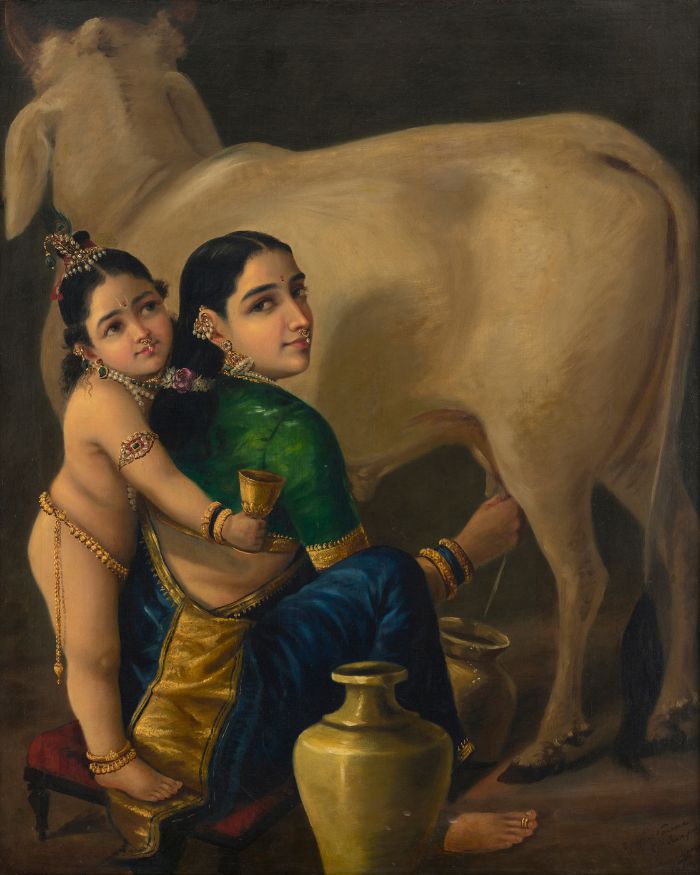
Read more: Raja Ravi Varma’s ₹167 crore painting: What’s really valued?

Subodh Gupta Mumbai NMACC
Kingdom of Earth (2016-26) visible from the fourth level; Photograph courtesy Nature Morte and the artist
SHARE THIS ARTICLE

You May Also Like

Watch

No results found.

Search
Close this search box.

No results found.