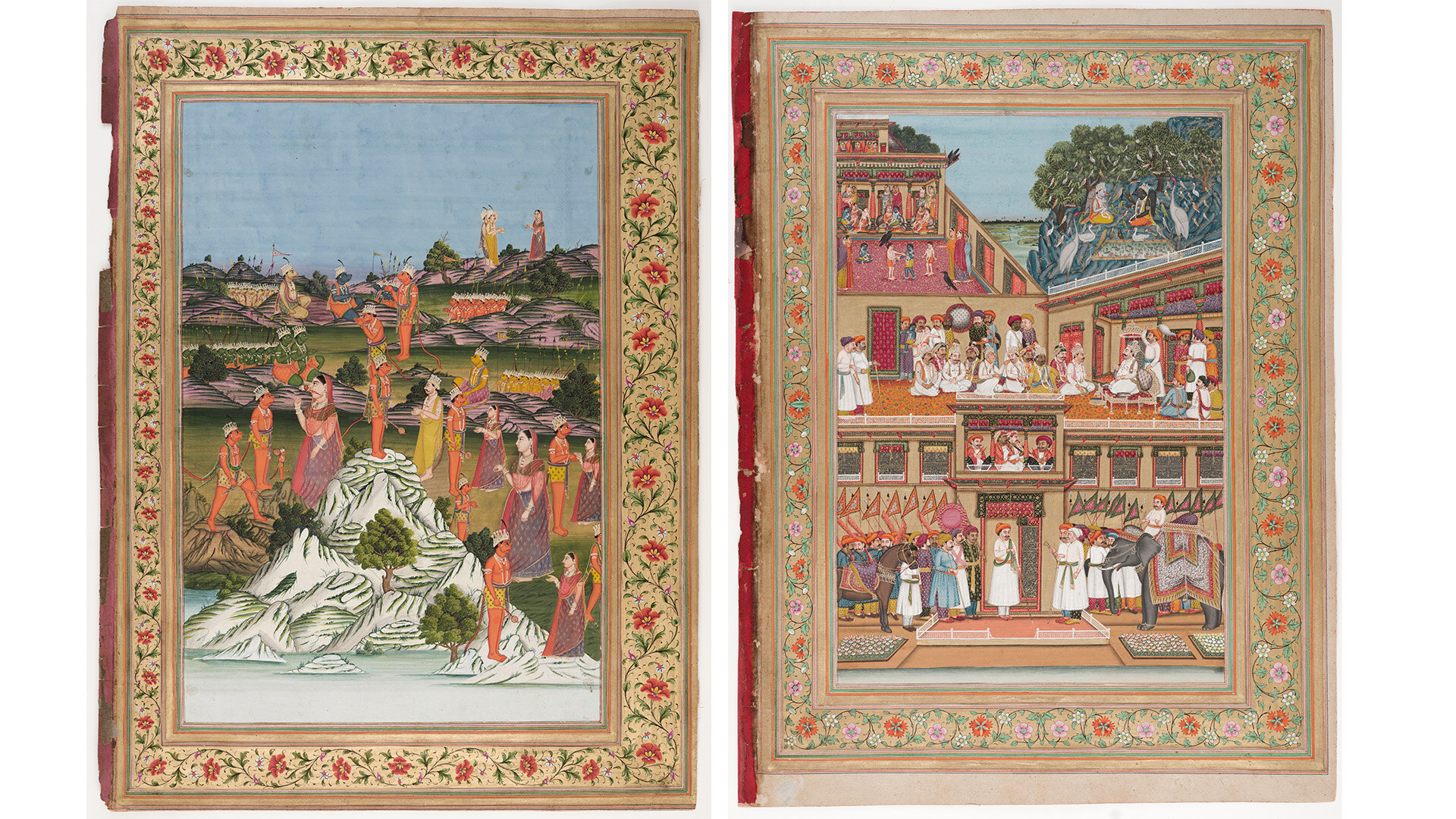
FROM LEFT Shiva describes to Parvati the blessings one can enjoy on Earth. 1814. Style D, Artists from the second wave of migrations from Jaipur. PTG.02228; Surasa tests Hanuman. 1812. Banaras, Uttar Pradesh, India. Opaque watercolor, ink and gold on paper. PTG.02203; Images courtesy of Museum of Art and Photography

Anniversary issue: Kanchana Chitra Ramayana

The book of gold and the incalculable value of mehnat

BY

There’s a particular quality to work done carefully and meticulously — by hand, with care, detail after detail, meant to last for centuries — that transfixes each one of us that encounters it. The Kanchana Chitra Ramayana (Book of Gold) is one such work, which invites you to pause, look closer and find more to discover. Hundreds of years after its creation, this astonishing book continues to offer visual testimony to the untold mehnat of hundreds of painters, scholars and scribes, whose contributions live on within its pages. One of the most expensive manuscripts ever commissioned, the ‘Book of Gold’ was commissioned by the Maharaja of Benaras, who ordered that all 1,100 pages of the 7 volumes be richly gilded, and no expense was spared. The ‘Kanchana’ in its name comes from the lavish use of gold, which would be ground fresh every morning to be mixed into pigments to line the verses, and burnish 548 full-colour paintings that accompanied each page of text, and ‘Chitra’ meant that every page of text was to have a corresponding image illustrating it.

When the royal scion of Benaras, Udit Narayan Singh, first conceived the mammoth project in 1796 — mere months after ascending the throne — there was no precedent to such an ambitious undertaking, which would eventually take 18 years to be completed. Udit Narayan’s patronage ensured that the ancient city turned into a hubbub of activity for decades to come, with master artists from various ateliers across India arriving in Benaras, setting up karkhanas to bring his vision to life. A glance at the Kanchana Chitra Ramayana offers a look at a multiplicity of styles, characteristic of individual schools of miniature paintings, from Murshidabad, Datia, Faizabad, Lucknow, Awadh, Jaipur and the Mughal court. Art historians credit the project with bolstering the tradition of miniature painting at a time when the art form was in decline. The timing of this maximalist cultural endeavour tells its own story. By the late 1700s, Mughal patronage was on the wane. The East India Company had signed treaties with Hindu rulers, including Udit Narayan Singh, forcing them to renounce most of their authority.

No longer permitted to maintain his own army, mint currency, or preside over the judiciary, the Benaras royal turned to the cultural sphere to retain the last vestiges of his influence over his republic. He began by building visible architectural projects, constructing large water tanks, pleasure palaces, extensive gardens, and towering temples to Ram in a city traditionally associated with Lord Shiva. The Benaras dynasty’s interest in Ram was not unique to the time. As Mughal authority crumbled, a number of Hindu rulers turned to Ram not just as a deity worthy of worship, but as an Indic model of a righteous and victorious ruler. The commissioning of the Kanchana Chitra Ramayana helped cement this narrative because it relayed the story of Lord Ram’s glorious rule in Awadhi, the language of the people. While the Ramayana itself has been in circulation for more than two millennia, written in Sanskrit and attributed to Sage Valmiki, millions of people in North and Central India are only familiar with the version of the epic retold by the saint-poet Tulsidas, who portrays Lord Ram as a divine, infallible being within his Ramcharitmanas.
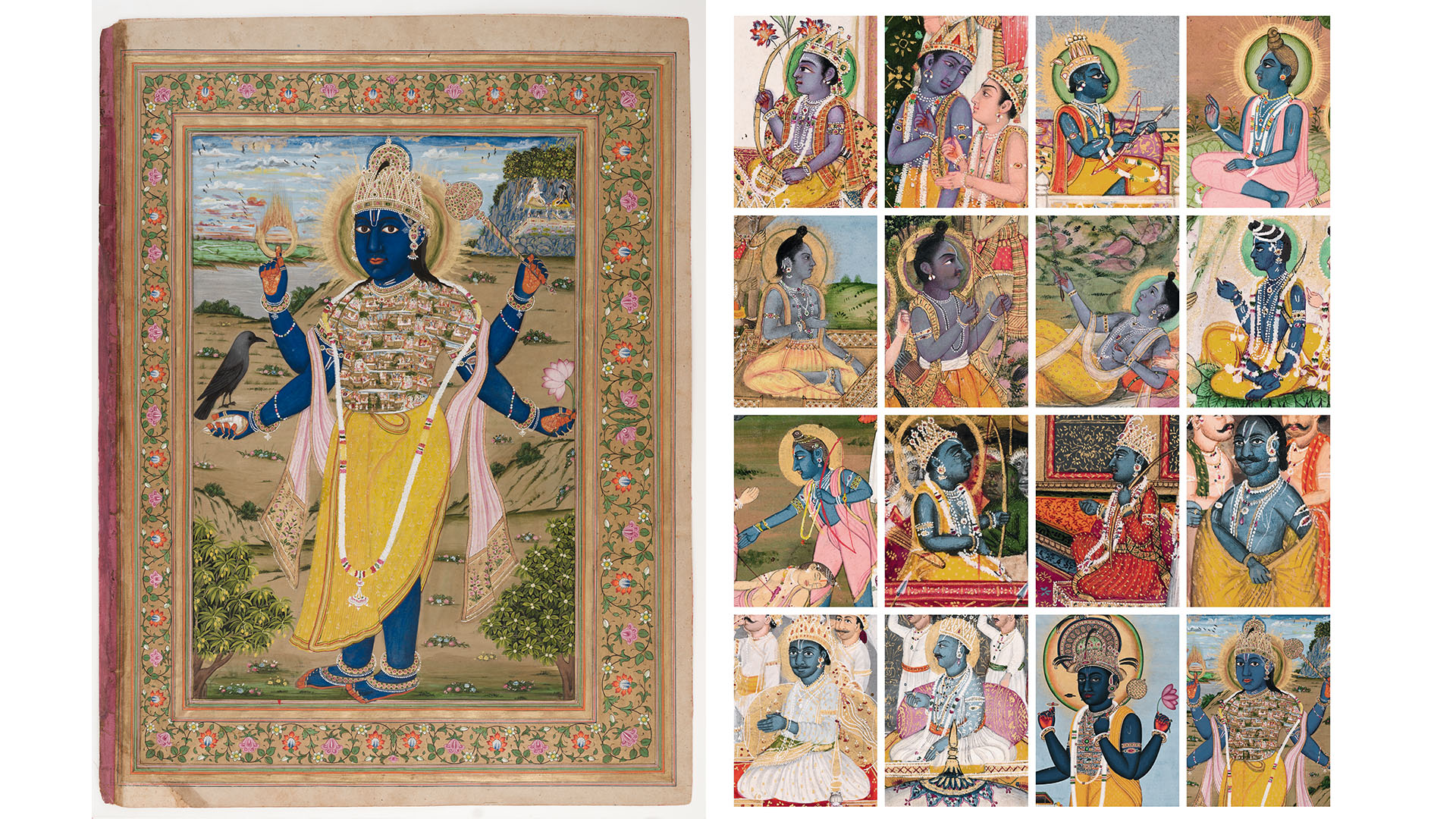
FROM LEFT Rama as Vishwarupa blesses Kaka Bhushundi with wisdom. 1814. Style D, Master-artist from the second wave of migrations from Jaipur. PTG.02336; Detail of Rama from different kandas of the Chitra Ramayana, showcasing the diversity of artistic styles within the illustrated manuscript; Images courtesy of Museum of Art and Photography

The city was already famous for producing the annual Ramlila (a theatrical re-enactment of key events from the Ramcharitmanas). Turning this into a 31-day-long pageant with royal patronage ensured that the Ramlila turned into a crowd puller. This spectacle was staged by a large cast trained by pandits, accompanied by reciters, with special costumes and elaborate effects that dazzled the public. The scale of the performances, set against the backdrop of Ramnagar, transformed the city across from the holy banks of the river, into Ayodhya from the Treta Yug, ruled by the just and ideal figure of Lord Ram, a likeness that Udit Narayan obliquely referred to himself in this manuscript. The Kanchana Chitra Ramayana furthers Lord Ram’s mythology in popular imagination by including detailed illustrations to support and explain it in the local Awadhi verses, making the story easier to grasp. As one inscription from the period notes: “The learned understand Sanskrit, others understand Awadhi, but all who see the illustrated version understand at once.” This project thus became a parallel to the Ramlila — a visual record of the scenes of the story that were also enacted in the pageant.

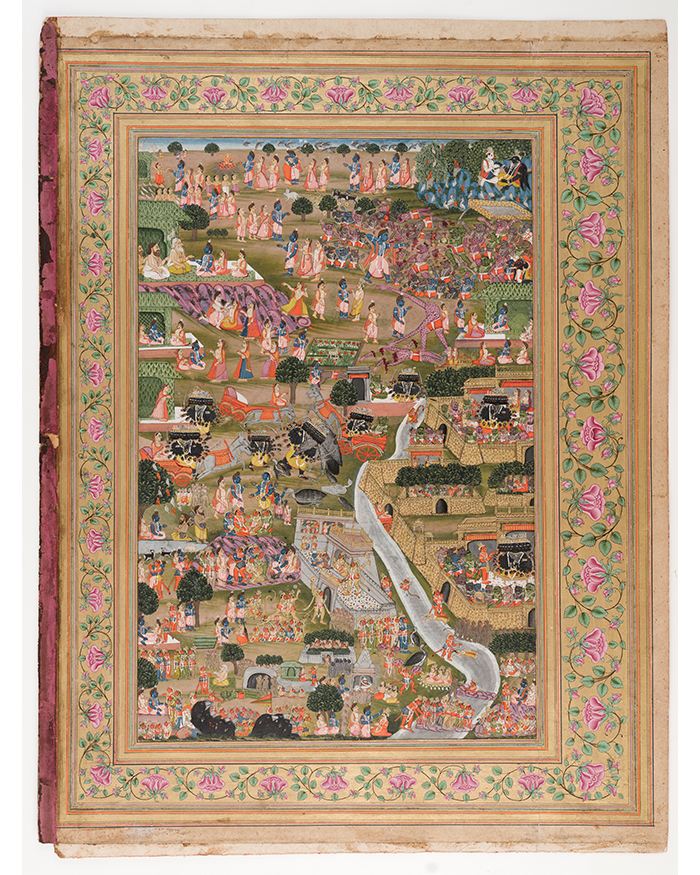
Unlike the traditional pothis, or horizontally laid-out pages of earlier Hindu religious texts, the Kanchana Chitra Ramayana is mounted vertically. The late art historian Kavita Singh notes that the book is clearly modelled on grand Mughal albums and meant to be their equal, with the folios of the book being more than two feet across when open. The broad margins of every page are decorated with the most exquisite floral meanders and arabesque patterns in lapis, gold and other pigments. Each page of text faces a richly illustrated, full-colour painting bearing the motifs of different artists’ hands, with a level of detail that makes the head spin. The original 7 volumes — one for each kand came wrapped in a woven Banarasi silk brocade cover bearing the emblem of the kingdom, two fish curved around a sun motif.

Inside its folds, individual folios visually interpret the story being told in the verses alongside to keep readers engaged. For instance, Hanuman is depicted 11 times in a single frame as he keeps growing in size to defeat the giant demoness Surasa, who keeps changing her own dimensions. Each figure is scaled to match the transformations described in the verses. The precision required for such work — measuring, counting, maintaining clarity across compositions that layered multiple scenes — demanded extraordinary planning, skill and attention.

The texts were decided first, the paintings came later. In portions where there is a lengthy conversation between two people that encompasses three long pages, the artists introduce variations and other details to ensure your attention doesn’t waver one bit. Don’t forget that the stories that went into the ‘Book of Gold’ had to be researched by scholars. Where different Puranas offered different versions of the epic, choices had to be discussed with Ramayanis — scholars versed in the Ramcharitmanas who served as expounders of the text.

More than two centuries after it was completed, the Kanchana Chitra Ramayana continues to invite closer attention. Its pages never fail to delight, and the scribes themselves exulted over the marvel they had helped create, calling this book “gem-like,” “shimmering,” coursing with “rivers of ink and gold.” At the Museum of Art & Photography (MAP), Bengaluru, we have been very fortunate to have several of the original folios, be a part of our collection. And thanks to the extraordinary work of our researchers, photographers, and archivists, led by curators Dr. Kavita Singh and Dr. Parul Singh in 2023, we displayed these folios as part of the exhibition ‘Book of Gold: The Kanchana Chitra Ramayana of Banaras’, when these folios were on public view for the first time ever outside of Varanasi. The exhibition will also travel to CSMVS (Chhatrapati Shivaji Maharaj Vastu Sangrahalaya) Mumbai in 2026. When you view these panels in person or online, you notice how the gold still gleams after centuries, how scenes nest within scenes, and how each page speaks to the meticulous labour of hundreds of artists at the peak of their powers. In the 1970s, Professor Richard Schechner, working for the American Institute of Indian Studies, was conducting a pioneering study of the Ramlila of Ramnagar and discovered the volumes of this forgotten manuscript in the Maharaja’s library, and got his permission to document each page. Using his documentation, MAP created a digital flipbook that is now available online, allowing viewers to see this manuscript in its entirety. All 1,100 pages from all seven kands are correctly numbered and accompany the corresponding illustrations. Many original black and white scans have been restored to full colour.

The individual labour it must have taken to bring every story to life is visible in every deliberate line and brushstroke. However, the pages also remind us how the ‘Book of Gold’ brought a parliament of artists together, united in a common purpose. It brings to mind the work of artists returning to their studios day after day to work side by side, inscribing, sketching, painting, gilding, stippling and embossing over 1,000 pages of a visual epic like no other. The ambition and scale of this project never diminished the mehnat evident in these folios — intellectual, material, spiritual — isn’t separate from what makes them spectacular. That quality of sustained effort, of work done with utmost care, an offering for God, where a single folio may have taken months to complete and several people to work on, leaves something behind that just can’t be replicated or rushed. When you look closely, the paintings make demands on your attention that mirror the attention that would have gone into making them. These folios of amazing detail and beauty invite us to imagine that such devotion is still possible — that we’re still capable of singular focus, even in this age of distraction. Perhaps that’s what makes Kanchana Chitra Ramayana an invaluable symbol of our collective resistance. To care passionately, work slowly and sustain sincere effort over the years — might just be what makes us the most human.

Read more: https://elledecor.in/anniversary-issue-anica-mann-on-the-plural-legacy-of-india/

SHARE THIS ARTICLE

You May Also Like

Watch

No results found.

Search
Close this search box.