Produced by Mrudul Pathak Kundu
When you grow up surrounded by beauty and maximalism, do you ever learn to see it anew again? The answer to this can be simple, complicated or even unfound. “There is maximalism in my life, but it has become so normalised that it doesn’t appear maximalism anymore. And in that, there is beauty,” reflects Her Highness Dr Radhikaraje Gaekwad, Maharani of Baroda, settled with poise inside her home in The Lukshmi Vilas Palace, drawing a clear line between opulence and inheritance. Two words, which banally, are typical to the universe of maximalism. Her idea of de-rooting maximalism from the grips of a decorated universal identity is a pivotal inversion. For her, maximalism isn’t a matter of accumulation; it is the discipline to remember, to let history persist. She recollects the time spent with her grandmother in the Puja Room. “My earliest introduction to maximalism was in my ancestral home in Wankaner. Growing up, I was constantly surrounded by textiles and jewellery — my grandmother’s Puja Room was filled with them. All our trousseau jewellery was kept there. We all had our own wooden sanduks. Every time I visited, there would be something new from her. During her long puja — sometimes an hour or more — she’d keep me occupied by letting me pilfer through the sanduk. I’d pull out pieces, see them, play with them. At that age, they felt almost like toys.”
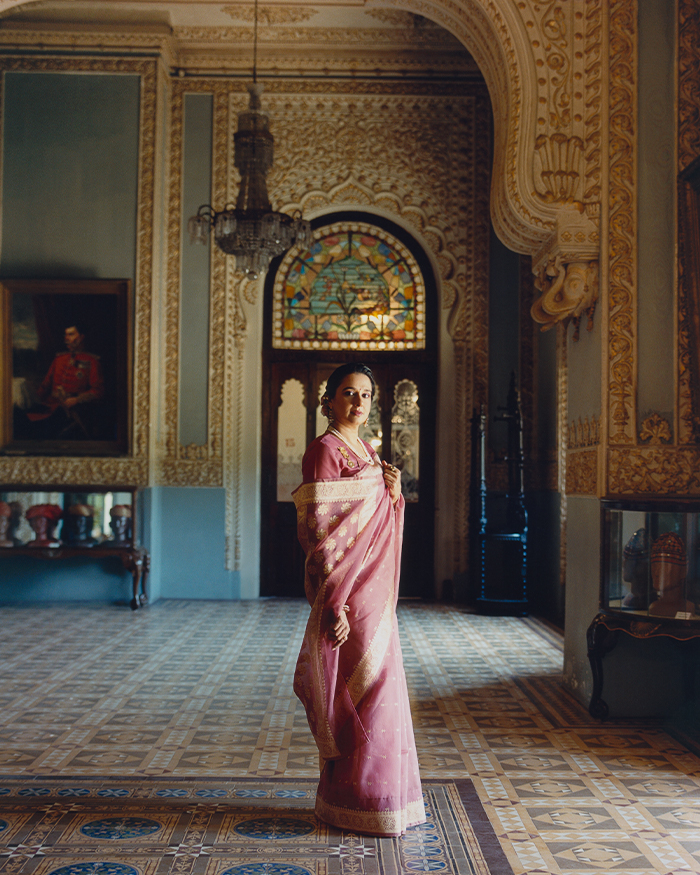
Today, Radhikaraje resides in the Lukshmi Vilas Palace, an Indo-Saracenic landmark built by Maharaja Sayajirao Gaekwad III in 1890. About 500 acres of complex and a monumental world of its own, the premises includes a golf course, Navlakhi stepwell, Moti Baug Palace and the cricket ground, the Maharaja Fatesingh Museum, the LVP Banquets & Conventions, offices of the Baroda Cricket Association, an indoor teak floored tennis court and a badminton court. A state and family’s royal legacy is not just a visual performance in isolation. What one sees is what has been safeguarded by the legacy keepers. “I must carry the legacy forward, improved than when I received it, or at least maintain the way it is. Whether it’s a home, reputation or an institution — that, for us, is a responsibility because we continue to remain in public life and in the cities where we’ve been for the last 300–400 years,” asserts Radhikaraje, whose academic timeline also includes a Master’s in Medieval Indian History at Lady Shri Ram College in New Delhi as well as her strengths as a former journalist and now a textile revivalist, heritage conservationist, social entrepreneur and managing trustee of the royal family’s trusts.
In fact, on one end of the spectrum, overabundance is counterintuitive in the royal households. “For me, maximalism is the opposite of excessive.” Of course, tangibly speaking, material heirlooms shape the inventory of the spaces they inhabit, but it is the intangible — history, protocols, rituals, responsibility and the societal influence derived from lineage —that defines the weight of maximalism for the royals. Born in the Wankaner royal family of Gujarat, whose establishment dates back to the 1620s, Radhikaraje married into the Gaekwad Dynasty of Baroda (current day Vadodara) more than two decades ago. And till date, on her strolls around the palace — dubbed as one of the largest private residences in the world — the incalculable, minute details of the architecture astonish her every time.
During our shoot today, I noticed two new peacocks!” She tells us and aligns her thoughts deeper into the context, “There is so much maximalism here that you look at its beauty in entirety. Sometimes you forget you’ve seen something, and then you rediscover it again. Over time, you need the leisure to see each detail on its own and it will speak to you in its own moment.” The Darbar Hall inside the palace is a place that holds many facets of maximalism, material and immaterial. “From a Persian-style ceiling in lacquer and mosaic flooring from Italy to rosewood lattice jaalis, stained glass from Heidelberg, cluster of chandeliers from England to teakwood apsaras clad in nineyard sarees. This is where the maharaja would address his subjects and ministers, receive international guests and host large banquets.” Now, every year, the Darbar Hall is where the royal family establishes the Ganpati idol during the 10 day-long Ganesh Chaturthi and opens it to the public in the last few days of the festival. When does religion become one with maximalism? Historically, the most prominent patrons of arts and crafts were the throne (the king) and the temple. Both shaped culture through literature, music, dance, architecture and food. “One space that is extremely auspicious for me is the Gadi Hall. It appears much simpler now. In certain sections, we’ve lost the original detailing. There was a chhaap of the crest, only one wall still has it, and we will restore it.” The importance of this room however is underlined by the original paintings by Raja Ravi Varma it holds. “It has the works of Lakshmi, Saraswati and Sita Bhoomi Pravesh by Raja Ravi Varma. These are placed before the Gadi to draw inspiration and seek blessings from the goddess.”
The two biggest patrons of craft were the king and the temple, and both shaped culture through art, music, dance, food and architecture, of which, customs and rituals were a natural extension. “Ritualism, a big part of Hinduism, was always entwined with royal regalia. You can’t separate it,” she adds, “So even when a king was anointed, mantras were chanted. Religion becomes a part of a maximalist way of life because any celebration or event in a royal family is never without seeking the blessings of the divine.” An embodiment of religion interspersing with royal celebrations is the Lukshmi Vilas Palace Heritage Garba, one of the largest ninenight garba gatherings, by scale and the tens of thousands of attendees. Held inside their royal estate at the Motibaug Cricket Ground during Navratri and organised by their trust Maharani Chimnabai Stree Udyogalaya and Maharaja Fatesingh Museum, the grand act of garba preserves the family’s cultural memories with the community becoming a part of it.
Dussehra for the Gaekwad household is the most spiritually and inherently maximalistic festival. But it is celebrated in absolute privacy without an audience. It begins with a red carpet rolled out for Maharaja Samarjitsinh Gaekwad, Radhikaraje’s husband, who walks on it with the family musicians performing sacred tunes in the background. The state anthem of Vadodara is played too. The throne is worshipped and so is the armoury, symbolic to the Kshatriyas, before the puja begins. These rituals are elaborate and precise, but the joy is in the fact that, “it is just the core family and we’re not doing it for an audience,” expresses Radhikaraje, whose resolve to preserve oral histories, regional crafts, textiles and forms of art come from the same instinct that shaped her childhood — that continuity is a conscious series of decisions. And what lives on is something more than material grandeur, surviving the strokes of age and time. So, we ask: For the royal households, is maximalism an act of preservation or a romanticised performance? Radhikaraje affirms, “I think it is an act of preservation for most. It has over time been honed into a notion of romanticism because that’s how people perceive it. If it helps bring focus, attention and resources to this ‘maximalism’ that we are trying to preserve, then so be it.”
“I think maximalism is an act of preservation for most. It has over time been honed into a notion of romanticism because that’s how people perceive it"
- Radhikaraje Gaekwad